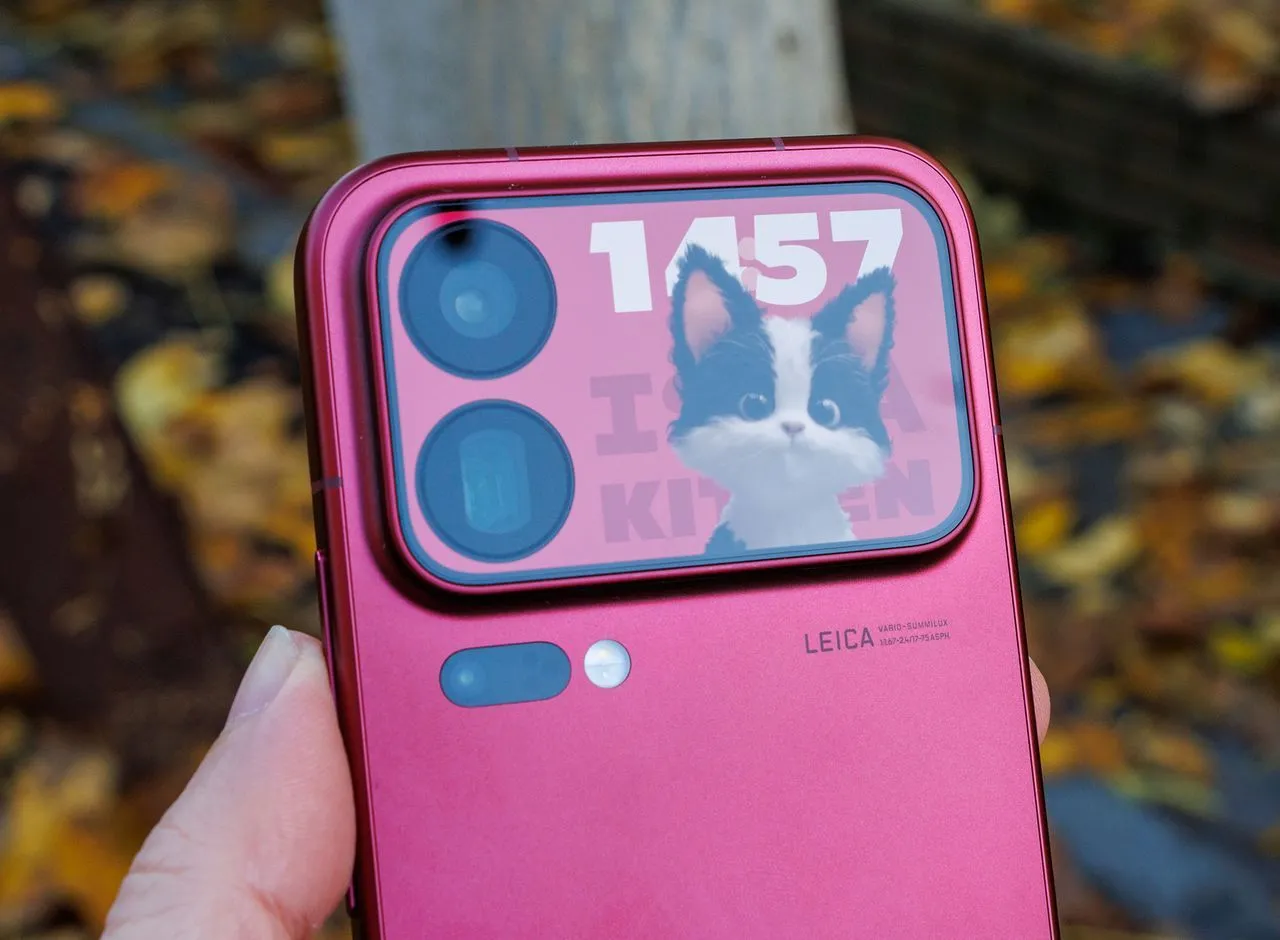
With its 6.9-inch display, the Xiaomi 18 Pro Max is a sizable smartphone. Our review unit in Velvet Red measures 163.39 x 77.6 x 8.39 mm and weighs 229 grams. The blue variant (Cosmic Blue) is slightly thicker and heavier at 8.47 mm and 234 grams. The build quality is excellent, and the finely textured matte surface of the red variant gives the smartphone a premium feel. However, its considerable weight quickly becomes noticeable when holding the device.
The large camera module with its integrated secondary display is a distinctive design feature and is protected by Corning Gorilla Glass Victus 2. Xiaomi uses its own Shield Glass 3.0 on the front, while the back panel is made of fiberglass. The display bezels are particularly narrow, measuring just 0.99 mm on all sides. The chassis is IP68-rated for dust and water resistance.
The rear display offers a surprisingly wide range of functions. Xiaomi uses a 2.9-inch LTPO AMOLED based on the M11 panel, with a resolution of 976 x 596 pixels (400 PPI), an adaptive refresh rate of 1 to 120 Hz, and a peak brightness of up to 4,000 cd/m², according to the manufacturer.
In addition to notifications, calls, and music controls, the display can show selected live activities such as navigation instructions. Text, screenshots, and images can also be pinned to the secondary display. One particularly useful feature is its ability to serve as a viewfinder for the rear Leica cameras. Selfies and vlogs can be captured directly using the small display, which also offers a teleprompter function. When taking group selfies, the smartphone can automatically switch to the ultrawide-angle camera as soon as it detects at least three people.
The so-called GenAI Apps allow users to create small applications for the secondary display using natural language prompts. Xiaomi also provides more than 50 prebuilt applications, including timers, score counters, and games. However, the generated apps are not full-fledged Android applications and cannot access the internet, other apps, or personal data.
An AI-powered interpreter uses both displays to show translations to the respective participants in a conversation. The international version is set to support 29 languages, with selected languages also available offline. The availability of Gemini Live on the secondary display depends on the market and supported services.
The 6.9-inch M11 LTPO AMOLED has a resolution of 2,624 x 1,208 pixels and operates at 1 to 120 Hz. HyperRGB 2.0 features a full RGB subpixel structure, with each pixel having its own red, green, and blue subpixels. New emitter materials are intended to improve efficiency, with Xiaomi claiming a 20% improvement for the green emitter compared to the M10 generation. Peak brightness is rated at 4,000 cd/m². The panel supports 12-bit color depth, HDR10+, and Dolby Vision.
One major innovation is the hardware-based privacy display. Xiaomi integrates two different types of pixels into the OLED panel at a 1:1 ratio. The so-called privacy pixels feature microscopic shielding structures that direct light primarily forward. When privacy protection is enabled, the conventional pixels are switched off. HyperOS 4 allows users to enable privacy protection selectively for individual apps, notifications, or windows.
In practice, however, the effect is disappointing. While the display remains clearer when viewed head-on, someone sitting next to the user can still make out the contents. Compared to the Samsung Galaxy S26 Ultra, the Xiaomi 18 Pro Max's privacy protection is considerably less effective. This limits the feature's usefulness, particularly on public transportation.
The Leica camera system consists of two 200 MP cameras and a 50 MP ultrawide-angle camera. The main camera uses the 1/1.28-inch Light Fusion 960L sensor with an f/1.67 aperture, a 23 mm equivalent focal length, and optical image stabilization. Using 16-in-1 pixel binning, the camera produces 12.5 MP images with an effective pixel size of 2.44 µm.
One notable feature is LOFIC (Lateral Overflow Integration Capacitor) technology. Additional charge storage capacitors allow the pixels to accommodate larger amounts of photogenerated charge before reaching saturation. Xiaomi claims a dynamic range of up to 16.2 stops. LOFIC HDR is available for supported photo and video modes on the main camera, but cannot be combined with the 200 MP mode.
The periscope camera uses the 1/1.56-inch Samsung HP5 sensor with a resolution of 200 MP, an f/2.4 aperture, and OIS. Its focal length is 75 mm (3.2x zoom). A so-called Power Prism not only redirects light but also handles part of the focusing process, allowing for a larger effective aperture within the limited available space. In-sensor zoom provides additional focal lengths of 150 and 300 mm. With a minimum focusing distance of 12 cm, the camera is also suitable for macro photography.
The 50 MP ultrawide-angle camera offers a 17 mm focal length, an f/2.4 aperture, and a 102-degree field of view. Its lens is noticeably smaller than those of the other two cameras, suggesting a considerably smaller sensor. Xiaomi has not yet disclosed its size.
The first sample photos taken with the Xiaomi 18 Pro Max impress with their natural color reproduction and high dynamic range. Despite the gloomy November weather, the different shades of autumn foliage are rendered distinctly without excessive saturation. Detail reproduction is also good, although fine vegetation structures appear slightly oversharpened in places.
Night photography is a particular strength. In the photos of the Christmas lights, both individual LEDs and darker structures in the background remain visible. The Xiaomi preserves the nighttime atmosphere rather than excessively brightening the scene. The photo of the imperial monument in front of the illuminated Ferris wheel demonstrates how well the smartphone handles large differences in brightness. Image noise is also low.
Weaknesses become apparent when shooting directly toward light sources. Occasional ghosting is visible, while pronounced veiling glare significantly reduces contrast in one nighttime street scene.
Close-up shots also impress with their high level of detail and soft background blur. The photos of the glassware, in particular, demonstrate how well the Xiaomi captures fine surface textures and light refraction. The shallow depth of field allows for attractive subject separation, although it requires careful selection of the focus point when photographing subjects with considerable depth.