At the cafe in Delhi's Talkatora Garden, Siddharth walks in with his almost-girlfriend and asks the waiter what's good here. "Mahaul achha hai," comes the reply: "The atmosphere is good."
Sai Paranjpye, who wrote that line for 'Chashme Buddoor' in 1980, later said 'mahaul' is a "very precise Urdu word that cannot be readily translated". You could say 'vibe', perhaps.
The cafe is long gone, and so is much of the Delhi the film captured.
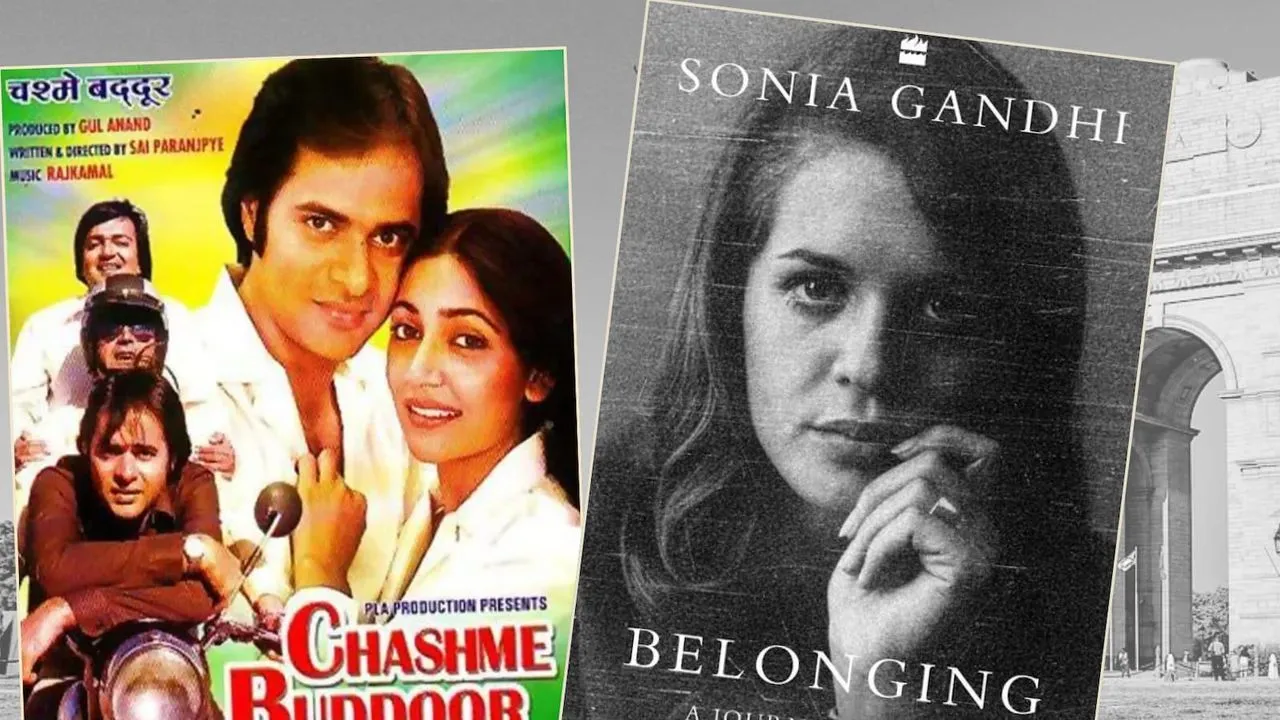
In 'Belonging: A Journey of Love', Sonia Gandhi brings it back on the page.
The Congress leader's memoir, released on November 10, opens its Delhi cityscape story at 5:15 am on January 13, 1968, when a young Italian woman who had met Rajiv Gandhi in Cambridge landed in the capital. The city she goes on to describe is recognisably the one through which Sid, Omi and Jomo ride a motorbike in Paranjpye's cult classic. A city of quiet roads, ruins at the edge of town, ice cream at India Gate, and a life that lost a race it couldn't opt out of.
Paranjpye called her film a "Dilli darshan". Read alongside it, Sonia Gandhi's book offers a darshan, a viewing or tour, of its own.
Sonia Gandhi's memoir is mainly personal, with politics as a backdrop. Photo: IANS
City Of Jackals And Cycles
The capital Sonia Gandhi arrived in barely looked like one, with an airport that was a "poorly lit hangar sort of building". She recalls, "I would be jolted awake by howls from jackals -- I was told -- roaming at night in the forested Ridge nearby." By day, the roads belonged to slow movers, she writes: "There was hardly any motor traffic in New Delhi. Hordes of bicycles filled the streets during office hours like giant black moths, for me a rare sight."
On a three-wheeler ride to Connaught Place, she was baffled by the "blood-red stains on corner walls everywhere we went -- what on earth were they?"
"Spat-out betel juice, I learnt," she writes.
Somebody had to be selling all that betel, wrapped in a paan. In 'Chashme Buddoor', it is Lallan Miyan, at whose stall the boys run up a tab mainly for cigarettes. Paranjpye set the stall "bang on a main road in Nizamuddin", on Mathura Road, which she remembers as being on the "outer extremity of Delhi, and difficult to reach". Today it runs through the middle of the city.
The film is essentially a "feel-good" tale of three friends: Siddharth Parashar, played by Farooq Sheikh (C), a shy student of economics who rarely interacts with women; Om Sharma 'Omi' (Rakesh Bedi, more recently known for 'Dhurandhar'), a boisterous, self-proclaimed ladies' man; and Jai Lakhanpal 'Jomo' (Ravi Baswani), who believes he looks too good to be ignored by women.
Freedom On Two Wheels
Sonia Gandhi got around much as the boys did, on two wheels. To learn Hindi, she rode pillion on a Suzuki moped to an institute in Green Park, with her friend at the handlebars. "Those were hair-raising rides, with Sabina struggling to balance the vehicle and navigate a passage as pedestrians, scooters, and bicycles appeared from all directions, ignoring traffic regulations," she writes. Then came a Vespa, the scooter designed in her native Italy.
"I think with nostalgia of the days of relative freedom and ease, when we could zip around town freely on the little grey Vespa scooter Rajiv's mother had given him, before the need for security limited our movements," she reminisces.
The boys in the film are freer still. All three pile on to Siddharth's motorbike and sing their way across the capital, and Paranjpye lists what her camera caught: "Shady avenues, the majestic India Gate, the ruins of Purana Qila and other broken-down relics dotted across the panorama, the colourful bazaars of ancient ghettos." The ride ends with a Sardarji policeman writing them a challan.
Director Sai Paranjpye with Saeed Jaffrey's Lallan Miyan and Farooq Sheikh's Siddharth. Photo: IMDb
There were no flyovers to ride over yet. Those came with the 1982 Asian Games, which Sonia Gandhi writes about: "New infrastructure had to be built from scratch in record time -- stadia, hotels, roads, and flyovers." Rajiv Gandhi, on the organising committee, was in the thick of it. 'Chashme Buddoor', released in May 1981, got to the city a year before the bulldozers did, and froze a Delhi that Sonia Gandhi's memory now confirms.
Both carry 1982 Asiad as a cut-off of sorts for that Delhi.
Dotted By Monuments, Washed By Rain
Leisure, in that Delhi, meant the lawns of the Central Vista, with India Gate at one end, where many families gathered every evening. "Rajiv and I drove there often and would stop at our favourite ice cream vendor's cart for his vanilla cone," Sonia Gandhi writes.
The film's motorbike song, too, starts at India Gate. Its romance runs on ice-cream. At Talkatora, Neha (Deepti Naval) orders tutti-frutti, Siddharth (Farooq Sheikh) settles for coffee, and the mahaul is free.
Beyond the monuments, the city thinned fast as Sonia Gandhi writes of the family farmhouse at Mehrauli, with a mango orchard and shisham trees planted by Indira Gandhi's husband, Feroze Gandhi.
Tughlaqabad Fort was built by Ghiyasuddin Tughlaq, the founder of the Tughlaq Dynasty, in 1321. Photo: incredibleindia.gov.in
A little further out, the memoir and the movie arrive at the same ruin and describe it in almost the same words.
Sanjay Gandhi, Sonia's brother-in-law, was usually behind excursions such as a drive to the picturesque medieval fort of Tughlaqabad, then on the outskirts of Delhi. Paranjpye shot the film's kidnapping climax on the slope of the fort. Her unit was assured, she remembers, "It's a deserted area. No one will bother you." Yet a huge audience descended from the nearby villages. Now the villages have folded into the ever-expanding urbanscape.
Indoors, the film opens in a barsaati thick with cigarette smoke, the three friends sprawled about. The barsaati, from barsaat or rain, was the rooftop room that took the monsoon head-on, and the film's much-loved song, 'Kahan se aaye badra', asks where the clouds have come from.
Sonia Gandhi's first Delhi monsoon came in the government bungalow she shared with Rajiv Gandhi. "I'd never before seen so much rain fall in such quantities and at such a speed: the garden flooded, the sky no longer visible, the sun gone into hiding," she writes.
Where Two Delhis Diverge
But the two Delhis aren't that similar after all when it comes to the deeper, inner worlds.
Paranjpye's Delhi is the South Delhi colony, the barsaati for the boys and, nearby, "a neat little doll's house, complete with a garden" for Neha. Sonia Gandhi's inner world is government bungalows, which she found depressing, with "the floors of blotchy terrazzo, the windows small, the rooms cold and dingy".
She nearly crossed over into the world of 'Chashme Buddoor' in 1980, the year it was shot. After Indira Gandhi returned to power, the family was to move back into the government house on Safdarjung Road. Rajiv and Sonia Gandhi had other plans. The years out of power had brought differences of opinion and heated arguments between Rajiv and Sanjay Gandhi, and the couple felt it was no atmosphere for the children to grow up in. "We'd rent a small flat somewhere so as to lead a normal life, far away from politics," she writes of the plan. Indira Gandhi pleaded with them to stay, even enlisted relatives to change their minds. They gave in.
Sonia and Rajiv Gandhi with their children, Rahul and Priyanka. Photo: HarperCollins
An iconic sequence is when Deepti Naval's Neha comes to sell detergent, 'Chamko Sabun', to the hero's barsaati residence. Photo: IMDb
What followed was the decade that took away the freedoms the film's characters take for granted. Sanjay Gandhi died, Indira Gandhi was assassinated, and Rajiv Gandhi became Prime Minister. The film, by contrast, keeps politics out of its Delhi altogether. That was the brief. Producer Gul Anand wanted a feel-good film with no social message attached, Paranjpye writes in her memoir, 'A Patchwork Quilt'.
There is a quieter gap in the lingo. At home, the Gandhis spoke "Hindustani, a mixture of Hindi and Urdu" -- the language of Lallan Miyan's languid 'aadaab', and of Omi's beloved shayari. The street outside spoke Punjabi. Two decades after Partition, refugees from Punjab had remade Delhi, though neither the book nor the film lingers on it. Sonia Gandhi touches on it through characters such as Usha Aunty, who introduced her to Indian folk music and handlooms, and who had fled her home in Lahore in 1947.
The Air That Was
But there's a foretelling, intended or not, when Mehdi Hassan sings Mir Taqi Mir, Delhi's 18th-century poet, in a set-up scene from the film. "Ye dhuan sa kahan se uthta hai" (Where does this smoke rise from?) goes the ghazal.
'Dhuan Dhuan' (Castles of Smoke, as she translates it) was the title Paranjpye first wanted for the film, eventually settling for the popular Persian/Farsi-origin phrase 'Chashme Buddoor' that means "far be the evil eye".
Given what became of Delhi's air, 'Dhuan Dhuan' might have read like an omen.
The film was shot in months that now mark the start of Delhi's smog season. On screen, the sky over India Gate is clear. Even a decade later, in 1990, spending a December week at the Mehrauli farmhouse with her family, Sonia Gandhi found the skies blue and the air "clean and crisp, the calm broken only by birdsong". Delhi had about 60 lakh people in 1981 and nearly 1.7 crore by 2011, and is estimated at over 2.3 crore now, not counting the NCR towns of Gurugram, Noida, Ghaziabad, Faridabad, and beyond.
Of the city now, Sonia Gandhi writes, "Come autumn, the city air begins to get oppressive, and by December, it gets labelled 'hazardous' or 'toxic'."
"Mahaul achha hai," the waiter at Talkatora had said. He might not today.