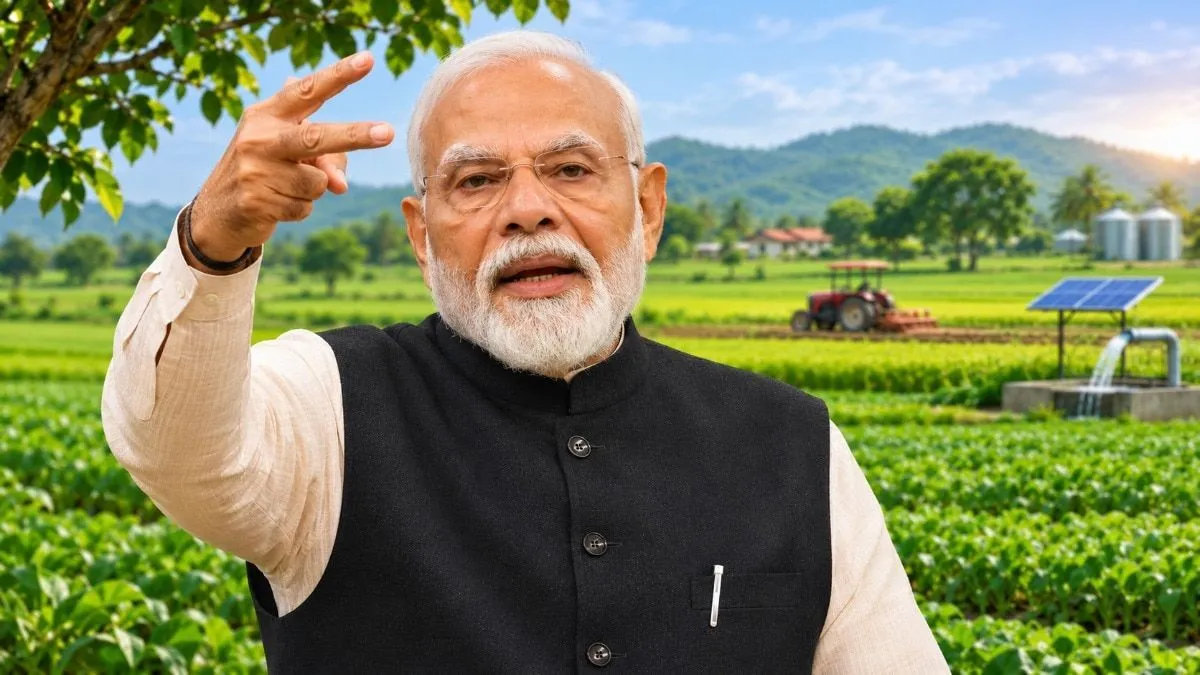
Prime Minister Narendra Modi on Thursday made a strong pitch for natural farming, warning that the use of chemicals in agriculture was destroying Mother Earth.
Addressing the India Today Group's Kisan Tak Bharat Agriculture Conference at New Delhi's Bharat Mandapam, PM Modi appealed to farmers to move towards chemical-free cultivation. He made a clear distinction between organic and natural farming, and emphasised that he was advocating the latter.
"The way we are using chemicals, we are destroying Mother Earth. We are her children, and we are killing our own mother before our eyes," he said at the India Today Group event.
The Prime Minister, who has repeatedly advocated natural farming at various events and platforms, warned that failing to protect agricultural land from chemical damage could have serious consequences for future generations.
PM Modi's remarks came during his address at Bharat Mandapam, where at least 2,000 farmers, agricultural scientists and industry representatives had gathered for the two-day conference. Modi's warning followed his account of how the Centre had spent heavily to keep chemical fertilisers affordable for farmers, after the war in the Middle East disrupted supply chains. He said the government had spent Rs 16 lakh crore over the past 12 years to subsidise fertilisers and shield farmers from rising input costs.
The Prime Minister said the government had spent Rs 16 lakh crore over the past 12 years to provide fertilisers at affordable prices. While defending these subsidies, he also highlighted technologies that could help farmers determine how much fertiliser their soil actually needed. His concluding appeal, however, went beyond reducing fertiliser consumption to promoting natural farming.
Modi's warning comes nearly four months after the Centre moved to ban paraquat, a highly toxic herbicide widely used on Indian farms. On July 14, India Today Digital reported that the Agriculture Ministry had issued a draft notification proposing a nationwide prohibition on paraquat, which has been banned in more than 70 countries. The proposed ban followed years of concerns over poisoning, serious health risks and the chemical's misuse in agriculture.
WE ARE KILLING OUR OWN MOTHER: PM MODI
Modi's strongest warning came towards the end of his address, when he appealed to Indian farmers to consider the consequences of chemical use.
Referring to the earth as Mother Earth, Modi said that humans were destroying the very soil on which they depended.
"I want to say something to my farmer brothers and sisters about two things: the food provider and Mother Earth. Are we protecting Mother Earth?" he asked.
He warned that failure to act could leave future generations facing serious consequences.
"The way we are using chemicals, we are destroying Mother Earth. We are her children, and we are killing our own mother before our eyes," PM Modi said.
"If we do not wake up in time, if we do not make efforts to protect our Mother Earth, a situation may arise when she abandons us before our very eyes," he added.
He then made a distinction between two farming approaches often mentioned together in discussions about sustainable agriculture. "I am not talking about organic farming. I am talking about natural farming," Modi said.
WHY NATURAL FARMING AND NOT ORGANIC?
Although both sustainable farming approaches avoid synthetic chemical fertilisers and pesticides, the government distinguishes natural farming from organic farming on the basis of inputs and cultivation practices.
According to a 2022 statement by the Union Agriculture Ministry, natural farming seeks to eliminate dependence on externally purchased inputs, including certain organic fertilisers.
It relies instead on locally available materials and traditional agricultural practices, including preparations made from cow dung, cow urine and plant-based ingredients.
Organic farming, meanwhile, can use inputs such as vermicompost, enriched manure and biofertilisers, as explained in the government's statement.
The Centre government has promoted both approaches through separate programmes.
The Paramparagat Krishi Vikas Yojana (PKVY), launched in 2015, promotes organic farming, while the National Mission on Natural Farming (NMNF), approved in November 2024 with an outlay of Rs 2,481 crore, encourages chemical-free cultivation.
The Centre also runs the Mission Organic Value Chain Development for the North Eastern Region (MOVCDNER), which supports organic farming, certification, processing and marketing.
The distinction between organic and natural farming techniques made by PM Modi on Thursday is in line with the Centre's existing policy preference for encouraging farmers to reduce dependence on purchased agricultural inputs.
RS 16 LAKH CRORE SPENT ON FERTILISERS: PM MODI
Earlier in the same speech at the Kisan Tak event, PM Modi also spoke about the government's expenditure on fertiliser subsidies.
He said Rs 16 lakh crore had been spent over the preceding 12 years to ensure farmers received fertilisers at affordable rates. PM Modi claimed that a bag of DAP fertiliser costing Rs 5,000 was being made available to Indian farmers for around Rs 1,300.
Similarly, he said a bag of urea costing Rs 3,000 internationally was being provided for less than Rs 300.
His remarks came a day after the Union Cabinet approved a Rs 62,370-crore subsidy allocation for phosphatic and potassic fertilisers for the October 2026 to March 2027 rabi season, according to Reuters.
MODI'S PUSH FOR NATURAL FARMING IS NOT NEW
PM Modi has repeatedly advocated reducing chemical dependence in agriculture. In 2021, while addressing the National Conclave on Natural Farming, he said, "We have to take our agriculture out of the lab of chemistry and connect it to the lab of nature. When I talk about nature's laboratory, it is completely science-based."
The government subsequently approved the National Mission on Natural Farming in 2024, with an outlay of Rs 2,481 crore.
According to the Agriculture Ministry's 2026 parliamentary reply, 18,786 natural farming clusters had been formed, covering 8.80 lakh hectares, with 18.19 lakh farmers enrolled as of March 5.
The mission also provides incentives of Rs 4,000 per acre annually for two years, limited to one acre per farmer.
At the South India Natural Farming Summit in Coimbatore in November 2025, PM Modi had similarly urged farmers to try natural farming on one acre for one season before expanding it.
So, his appeal at the Kisan Tak conference reinforced a longstanding policy goal, even as the Centre continues spending heavily to keep conventional and chemical fertilisers affordable.
- Ends