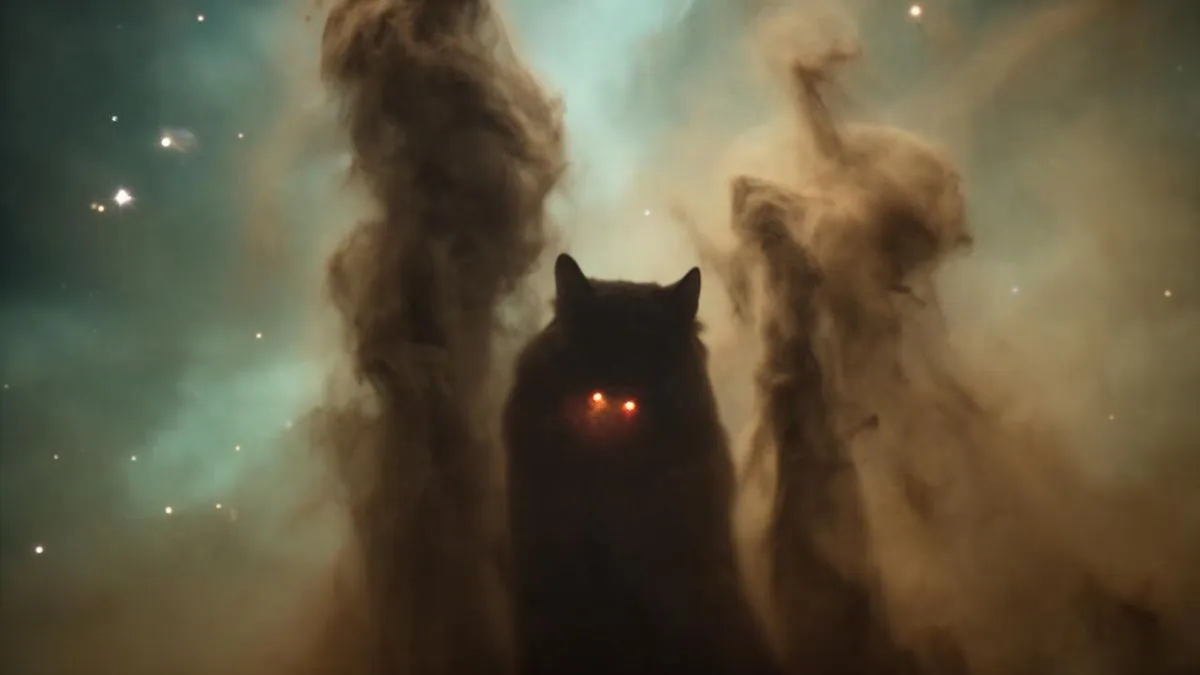
About 7,500 light-years from Earth, in the direction of the Carina constellation, drifts a nebula shaped like the giant profile of a cat. NASA and the European Space Agency (ESA) on October 29, 2026 released observation images of the "Cat's Head Nebula" captured by the Hubble Space Telescope and the James Webb Space Telescope. The Space Telescope Science Institute (STScI) that same day posted on YouTube a video titled "Multiwavelength Flight into the Cat's Head Nebula," which compares images taken at three different wavelengths while probing the nebula's interior.
The Cat's Head Nebula is a pillar-like structure carved out by the ultraviolet radiation and stellar winds emitted by massive stars. As surrounding gas and dust were eroded, denser portions that resisted the erosion were left behind, producing an outline resembling a cat sitting with its back turned. According to NASA and ESA, this structure is also destined to dissipate as star formation proceeds.
What stands out in this release is how dramatically the object's appearance changes when observed at different electromagnetic wavelengths. In Hubble's visible-light image, the nebula appears as a dark brown pillar of dust that blocks light, standing in silhouette against a glowing background. The yellowish haze along the right edge of the pillar matches the signature of gas ionized by ultraviolet radiation from a nearby massive star, suggesting that heated gas may be evaporating and dissipating.
As for the red-glowing "eyes" in the face, they are highly likely to be young stars buried within the dust. Light sources invisible in visible light because they are blocked by dust emerge as a red glow.
In Webb's near-infrared image, because infrared light passes more easily through dust, the pillar appears somewhat translucent, allowing the complex structure of its surface to be discerned. Numerous stars, shown in blue and yellow, appear around it, and the cat's eyes can be seen more clearly. Even distant galaxies are captured in the frame.
In the mid-infrared image, light emitted by warm dust and by carbon-bearing molecules excited by starlight is captured, revealing the intricate structure inside the nebula. Small clumps and filamentary structures on the left side of the pillar are especially clear, while the yellow-glowing source on the right appears to be a newborn star wrapped in dust.
Observed wavelengthTelescope usedWhat mainly becomes visibleVisible lightHubbleSilhouette of the dark brown dust pillar, red-glowing "eyes"Near-infraredWebbTranslucent surface structure of the pillar, numerous surrounding stars, distant galaxiesMid-infraredWebbWarm dust, emission from carbon-bearing molecules, internal clumps and filamentary structures
Note: Based on NASA and ESA published materials and STScI video descriptions
While details vary greatly depending on the type of light observed, the shape of the pillar that resembles a cat is broadly consistent. This shows that combining different wavelengths is an effective means of examining in detail the internal structure of star-forming regions. Phenomena such as the presence of young stars hidden by dust in visible light and the dissipation of ionized gas are made visible for the first time through infrared observations.
The Cat's Head Nebula occupies a corner of the Eta Carinae Nebula. The Eta Carinae Nebula is known as one of the most active star-forming regions in the Milky Way, and is a valuable target for observing massive stars violently eroding surrounding material. By pointing two space telescopes of different generations—Hubble and Webb—at the same object, researchers gained significant multiwavelength insights seamlessly connecting visible light through mid-infrared.
These images serve not only for astronomical research but also as educational material for broadly communicating the achievements of space telescopes. The video, which allows side-by-side comparison of the three types of images, is structured to help viewers visually understand the basic principle that an object's appearance changes with electromagnetic wavelength. Efforts to unravel the complex physical processes of star-forming regions will continue, and Webb's infrared observations are expected to contribute to clarifying the distribution and evolution of young stars hidden in dust.