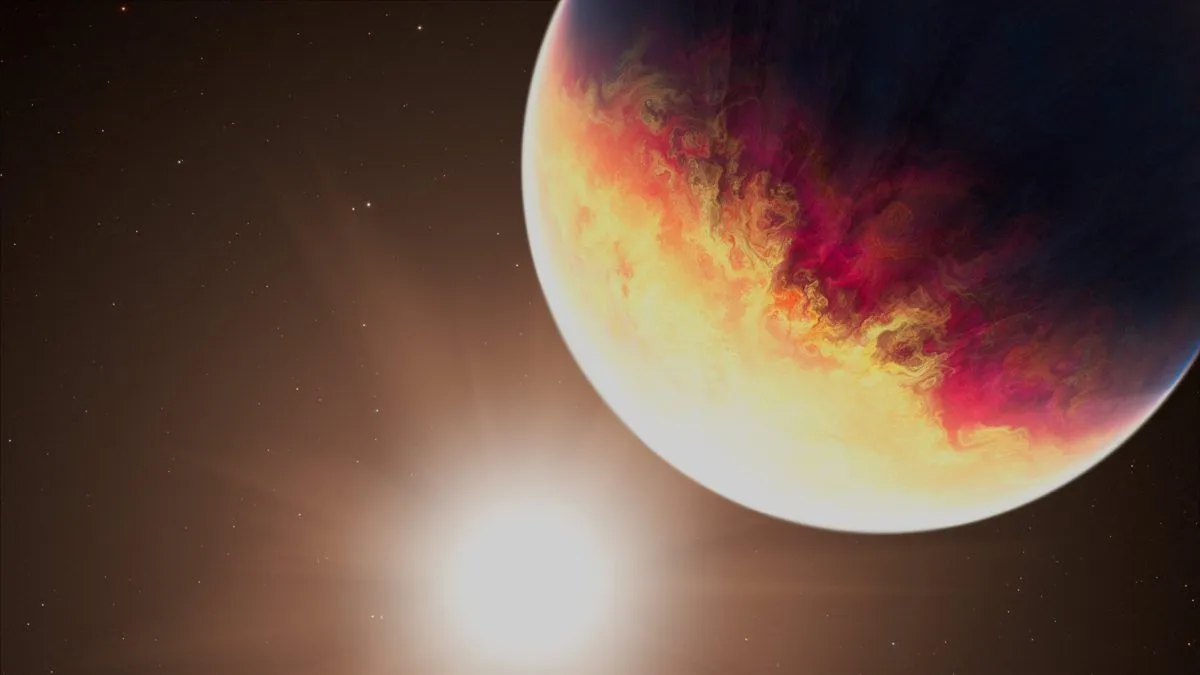
For seven years, a NASA telescope watched a planet the size of Jupiter cross in front of its star again and again — until one day it didn't.
The planet, TOI-2535 b, had been acting a little weird for a while. Each time it passed, which astronomers call a transit, it arrived as much as six hours early or late. The crossings also grew shorter and fainter.
Then, earlier this year, the planet just stopped showing up.
Astronomers knew an exoplanet could drift out of view like this, but they figured it would take decades or even centuries to happen. Imagine their surprise.
"The planet's orbit is tilting so quickly that its transit disappeared while we were watching," said Samuel Yee, a UCLA postdoctoral fellow and the study's corresponding author, in a statement.
The findings reveal the most extreme case yet of two worlds yanking on each other's orbits. The research also offers a rare clue to how giant planets could end up sidling so close to their stars. Scientists think most of these snuggly planets got there in some violent way. Perhaps a close encounter with another object, for example, knocked them onto a stretched-out orbit, and then their star reeled them in. But this pair likely took a gentler route and spiraled in slowly together, according to the new paper, published in The Astrophysical Journal Letters.
Planet TOI-2535 b sits about 1,000 light-years from Earth. It's what's known as a "hot Jupiter," a gas giant that orbits so close to its star that it finishes a lap in about eight days. By contrast, Mercury, our solar system's closest world to the sun, needs 88 days to make a revolution.
To be clear, NASA's TESS, short for Transiting Exoplanet Survey Satellite, never saw the planet directly. It infers the presence of a planet by catching the tiny decrease in starlight when one passes in front of its star. One day, TESS could no longer track those fluctuations.
But planets don't normally just disappear into thin space. Astronomers knew something else was going on.
Those fading crossings told the team that the planet's path was sliding from the middle of the star toward its edge until it was no longer traceable. The planet still circles its star, but from Earth it now passes above or below it.
UCLA astrophysicist and co-author Erik Petigura compares it to eclipses.
"If the moon's orbit around the Earth was perfectly aligned with the Earth's orbit around the sun, we would see an eclipse every month," he said. "But because the moon's orbit is tilted, eclipses are less common. The tilt of the moon's orbit is a relic of its violent formation history, which resulted from a collision with the early Earth."
Want more science and tech news delivered straight to your inbox? Sign up for Mashable's Light Speed newsletter or get Mashable push alerts today.
That raised a bigger question. What tipped TOI-2535 b's orbit?
Timing (or the lack of it) gave it away. A planet on its own crosses its star on a steady schedule. TOI-2535 b's early and late arrivals told the team that something unseen was tugging on it.
The researchers combined those timing clues with measurements of how the star wobbles as its planets pull on it. Everything pointed to a second planet, likely at least as massive as Saturn, circling nearby and also on a tilted orbit.
Nobody has seen that world, and for the same reason TOI-2535 b has gone AWOL. Its tilted path carries it above or below the star from our space telescope's vantage point, so the mystery planet never blocks any starlight that TESS can detect. But astronomers know it's there because of how hard it pulls on TOI-2535 b.
The two planets continue to pull on each other, so their orbits wobble slowly like spinning tops. The researchers expect TOI-2535 b to swing back into view in 30 to 50 years. But its hidden neighbor may show up sooner.
The pair also tells a story about the past. Astronomers have found hundreds of hot Jupiters, but these planets rarely have a massive neighbor close enough to tug on them. A violent fling couldn't have left two giant planets this close together, according to the research, so this pair likely took the scenic route.
But a gentler journey should have left the two orbits lying flat. Something had to have later tipped them, though the team doesn't yet know what. This star system may reveal a rare way of forming planets.
The discovery took patience. TESS's first four years of data wouldn't have been enough to reliably catch the change. As the telescope keeps watching, the researchers expect to find more planets slipping in and out of sight.
"We think of the universe as resembling clockwork, where everything is regular," Yee said, "but that's not true."