What if dinosaur bones could actually tell us what those ancient creatures were really like, not just in shape, but in the chemistry of their blood? That question doesn’t seem so far-fetched anymore. Scientists have just pulled off what you might call a real-life palaeontology plot twist. While analyzing a 115-million-year-old fossil from Brazil, a team discovered traces that look and act a lot like red blood cells, and even picked up chemical hints of a blood pigment that helps living animals carry oxygen. For ages, paleontologists assumed that anything as delicate as blood would be erased long before bones turned to stone. Now, that assumption looks a little less solid.
What happened?
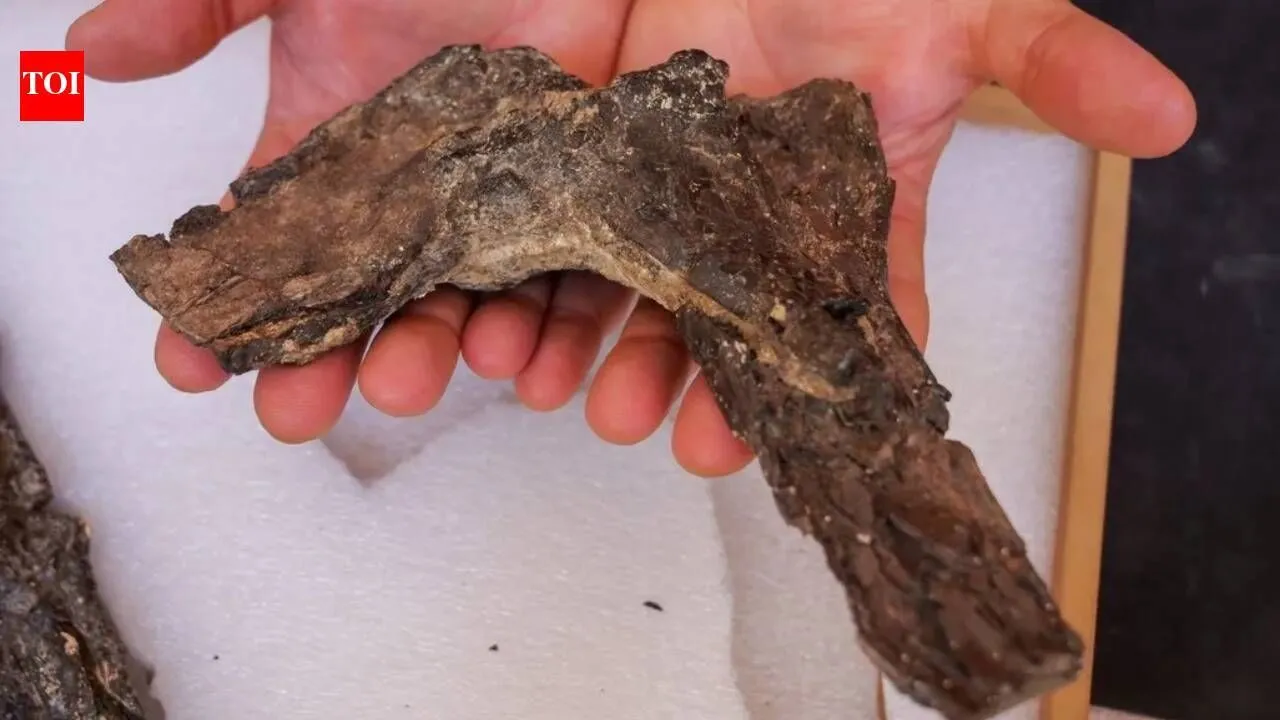
The dinosaur in question is Aratasaurus museunacionali, a meat-eater from the Early Cretaceous. A team led by Curtin University in Australia scoured its fossilized leg bones and says they've spotted a couple of mind-blowing things. Under the microscope, they saw tiny, oval structures shaped suspiciously like red blood cells. Chemically, they also found heme, which is the iron-rich molecule locked inside hemoglobin, the stuff that makes blood red and lets it carry oxygen throughout the body. Sounds pretty extraordinary, right? The findings hit the pages of Proceedings of the National Academy of Sciences (PNAS) recently, and it’s the kind of story that lights up group texts among scientists. Of course, the folks behind the research are quick to point out: these aren’t puddles of Jurassic blood. They aren’t even perfectly preserved dino cells. And they’re not claiming they’ve found dino DNA. However, they have uncovered mineralized cell-shaped specks carrying real chemical markers of blood, and that marks a huge leap in our understanding.
Where did this dinosaur blood surprise come from?
For starters, the fossil bones were hauled out of a gypsum mine in Ceará, Brazil, back in 2008. What survived were chunks of the right leg: femur, tibia, plus foot bones. The poor animal was probably about four years old and a little over three meters long. After the dig, the bones landed in Brazil’s National Museum collection. That’s where the real story picks up, as researchers began a much closer look inside. It turns out that fossil bones, if you look deep enough, can hide secrets in their tiniest structures. Deep within the mineralized vascular canals (the microscopic blood vessel tunnels in the bones), the team found those small ovals. Intriguing shapes, yes, but science isn’t satisfied with looks alone. So they upped the ante with a suite of tests: Raman spectroscopy, electron microscopy, and mass spectrometry. These tests didn’t just spot cell-shaped things. They caught traces of heme inside those very shapes, right where you’d expect to find it in living tissue. Even traces linked to collagen (the body’s structural protein) popped up. The result? As Curtin’s Professor Kliti Grice put it, actually seeing a heme signature inside those cell-like fossils after 115 million years is nothing short of stunning.
The big question: How did blood cells survive for 115 million years?
The answer probably lies in how and where the dinosaur died. Researchers suspect the animal perished in an environment covered in thick microbial mats: think slimy communities of bacteria. These mats, combined with a lack of oxygen as the animal was quickly buried, would have put decomposition into slow-mo. Over time, minerals, especially a manganese oxide called hausmannite, settled around the cells, kind of wrapping them in a natural time capsule. This protective mineral shell likely kept chemical traces of blood safe, surviving what would normally be an eternity’s worth of destruction. Scientists are now running real-world experiments using similar microbial mats to see if they can re-create these preservation tricks. Still, scientists aren’t holding test tubes of dino blood or eyeing strands of DNA. All this shows is that some chemical and cellular echoes of blood managed to ride out 115 million years. DNA, which is what you’d need to assemble a dinosaur, Jurassic Park style, is a totally different story, and there’s no sign it survived. Plus, not everyone is convinced these shapes are 100% red blood cells. Mary Schweitzer, a paleontologist known for her work with ancient soft tissues, points out that bird and crocodile red blood cells look different from mammals, and what’s in these fossils doesn’t tick all the boxes. Still, even she agrees the chemical evidence is compelling.
What does all this mean?
If future research backs these findings up, we might have a whole new way to learn how dinosaurs actually functioned. Fossils have already told us about their anatomy, movement, and how they changed over time. But with molecular clues like these, researchers could someday dig into dinosaur metabolisms, how their blood shuttled oxygen, and maybe even how they coped with ancient climates. It makes you wonder what other secrets are lying hidden in the bones that have been sitting in museum drawers for years, waiting for someone with the right tools to take a new look. And the implications don’t stop with the past. Studying how fragile molecules survive such monumental spans of time could teach us how to search for ancient life on other planets like Mars, maybe, or one of the icy moons circling Jupiter or Saturn. So, nobody’s reviving dinosaurs anytime soon. The debate around these new findings is just getting started. But the simple fact that a 115-million-year-old fossil can still whisper details about ancient blood is pretty wild. It just goes to show that the age of dinosaurs always has another surprise tucked away, just beneath the surface.
End of Article