An independent reanalysis of the data behind the first-ever image of a black hole has reproduced the iconic ring shape, closing a seven-year debate over whether the picture was an artifact of image processing.
A four-member team at the Commonwealth Scientific and Industrial Research Organisation (CSIRO) in Western Australia used a newly built imaging algorithm and machine-learning techniques to reprocess the original Event Horizon Telescope (EHT) dataset. Their reconstructed image of the M87 black hole is nearly identical in size and shape to the one released in 2019, according to a paper published in Nature on Nov. 12.
The result shores up the EHT collaboration's central claim: that general relativity accurately describes the warped spacetime around a black hole. It also removes a lingering asterisk from one of the most widely publicized scientific images of the past decade.
"It is like standing in your backyard and trying to take a photo of a doughnut on the Moon," Samuel Lai, a postdoctoral fellow at CSIRO and the study's lead author, said in a statement. "Importantly, our model had no idea what a black hole looked like when we applied it to the M87 data. This is the first truly independent validation of the EHT image, an important step in the scientific process."
Why the original image was questioned
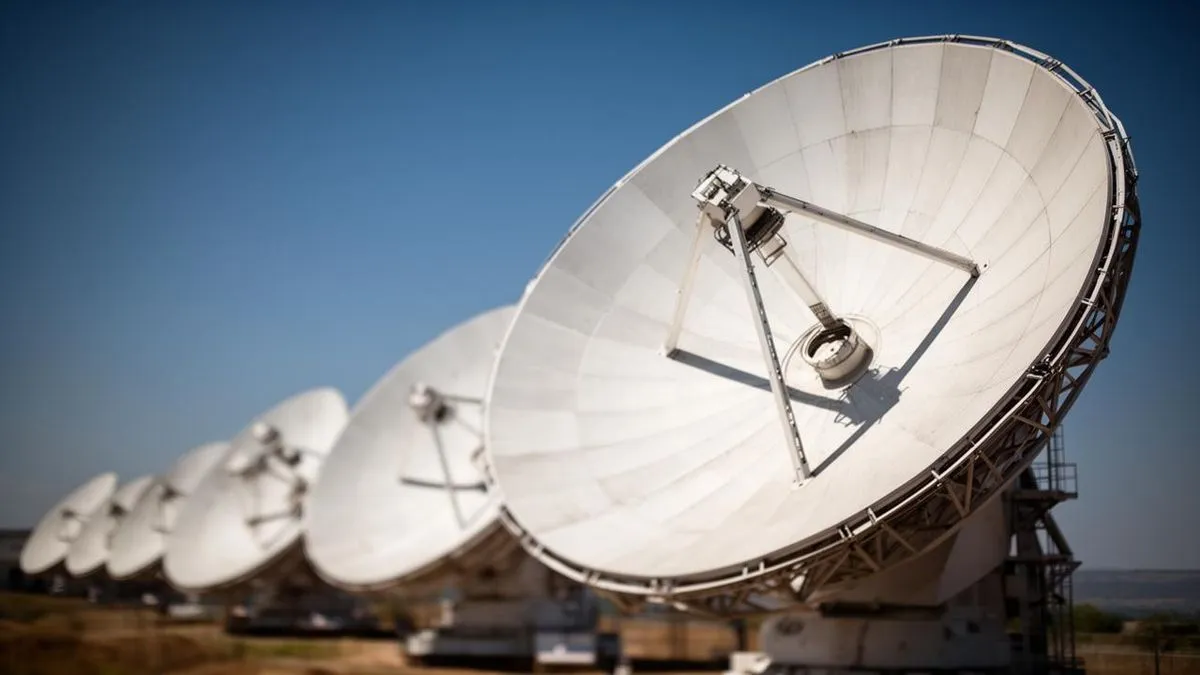
The 2019 picture showed a bright yellow-orange ring surrounding a dark central region, the black hole's shadow, set against the black of space. It was assembled from observations taken in April 2017 by radio telescopes at eight sites around the world, including the South Pole, Chile and Antarctica, linked to operate as a single Earth-sized antenna. More than 20 institutions took part, among them the Korea Astronomy and Space Science Institute.
The network's sparse geometry was both its strength and its weakness. With only a handful of stations, large gaps open up in the measurements, and software must fill them in. Observations at very short radio wavelengths are also vulnerable to distortion by the atmosphere.
"Because there are only a small number of telescopes scattered around the world, there are large gaps in the measurements that must be filled in by imaging algorithms," said Nithyanandan Thyagarajan, the CSIRO researcher who supervised the work. "And since observations are at very short radio wavelengths, the atmosphere can distort the signal."
That left more room for interpretation than in most astronomical data. In 2022, a team at Kobe University in Japan reported that applying the EHT's own analysis methods with slightly different assumptions produced no ring at all, only a clump of radio emission.
The new work attacks the problem on two fronts. Where the EHT processed telescope data in pairs before combining them, the Australian group bundled them in threes, a scheme the researchers say preserves information about the object's structure while canceling out errors introduced by the atmosphere or the instruments themselves. They also trained their machine-learning model on images that were not of black holes, so that expectations about what a black hole should look like could not bias the output.
ItemDetailTargetM87 black hole, center of the Virgo clusterDistance from Earth55 million light-yearsMass6.5 billion times the SunOriginal observationsApril 2017, eight radio telescope sitesOriginal release2019, The Astrophysical Journal LettersReanalysis publishedNov. 12, 2026, Nature
Note: Light-year figures and mass estimates are as reported by the EHT collaboration.
A century-old theory, tested at the edge of a shadow
Black holes were first conceived in the 18th century, but they became a subject of rigorous physics only after Albert Einstein published general relativity in 1915. His equations hold that a sufficiently massive body collapses under its own gravity until nothing, not even light, can escape. Compress the Earth to that density and it would span about one centimeter.
Because the object itself is invisible, astronomers image its shadow. The glowing ring is light from matter whipping around the event horizon at close to the speed of light before being swallowed. The black hole's gravity bends spacetime so severely that light from matter behind it is deflected forward, revealing an outline that would otherwise be hidden. One side of the ring appears brighter than the other because the disk is rotating: the portion moving toward Earth is boosted in brightness, the same Doppler effect that makes an approaching siren sound louder.
Laurent Loinard, director of the Event Horizon Telescope, welcomed the confirmation. "It is extremely gratifying to see that an elegant, entirely independent method recovers the ring structure of M87 across several years, in excellent agreement with the EHT Collaboration's published results," he said.
The agreement across several years of data matters because it suggests the ring is a stable feature of the source rather than a one-off quirk of a single processing run.
What it means
The finding is unlikely to move markets, but it carries weight for the next generation of black hole science. The EHT is expanding its array and targeting additional objects, including Sagittarius A*, the supermassive black hole at the center of the Milky Way. Independent verification of the processing pipeline gives researchers more confidence that features seen in those images reflect real structure rather than the assumptions baked into reconstruction software.
For the field more broadly, the result is a rare public demonstration of science's self-correcting mechanism: a headline-grabbing claim, a credible challenge, and a fresh analysis by a separate group that lands in the same place. The ring, it turns out, was there all along.