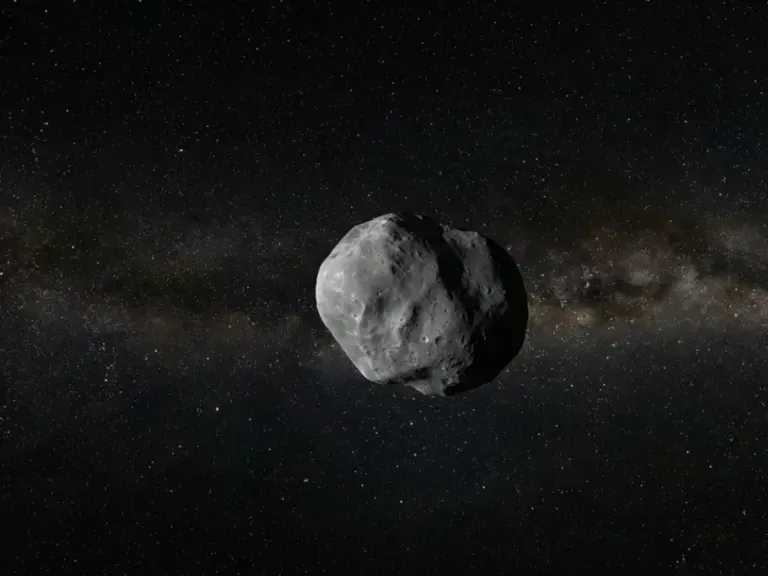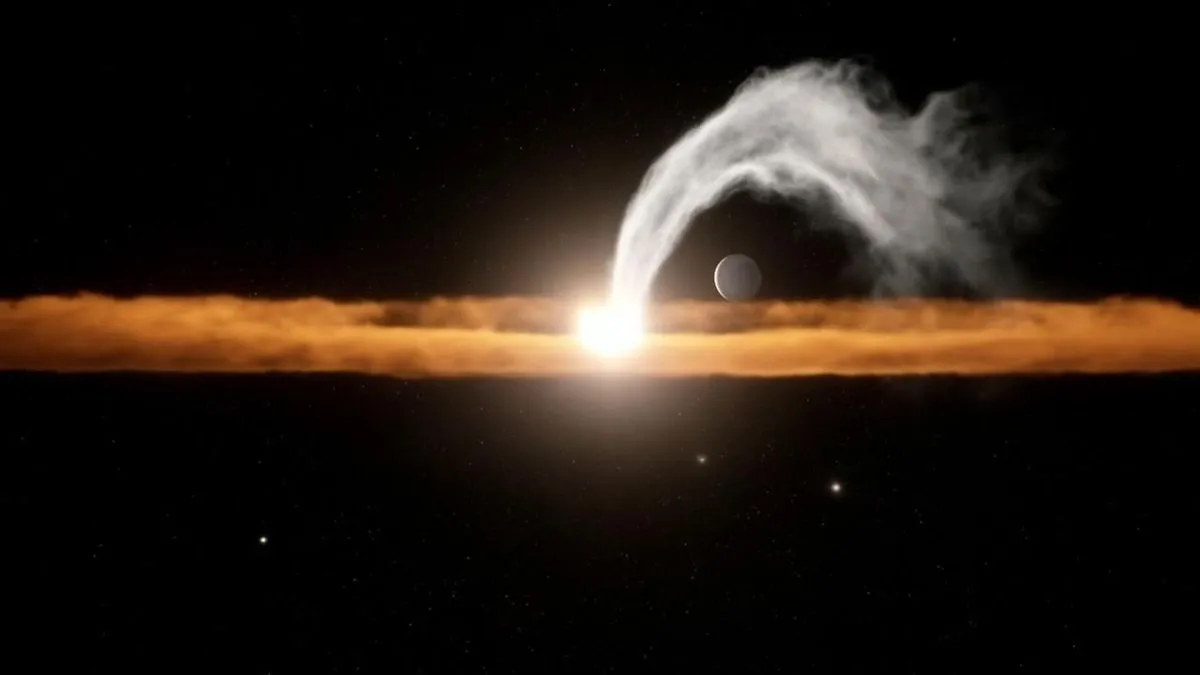
Astronomers have traced a vast, carbon-rich plume of dust jutting from the Beta Pictoris star system to what they believe was a violent crash between objects the size of Pluto, according to a study published in The Astrophysical Journal Letters.
The structure, nicknamed the "Cat's Tail," sits roughly 63 light-years from Earth in the constellation Pictor. It measures about 1,000 astronomical units, or some 93 billion miles, and extends from the debris disk surrounding Beta Pictoris, a star whose planetary system is far younger than our own.
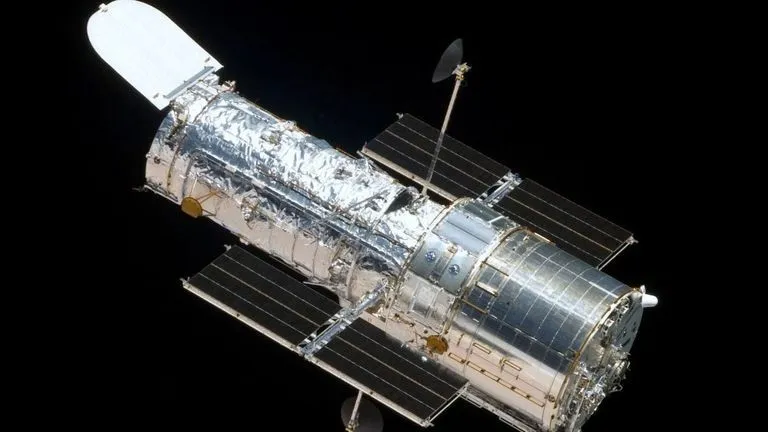
A team led by Arin Avsar, a doctoral student at the University of Arizona, combined fresh Hubble Space Telescope observations with archival images stretching back more than 14 years to model the feature's shape in three dimensions. The group's analysis indicates the tail may not trail behind the star as it first appeared, but instead stretches sideways relative to Earth's line of sight.
"We find that instead of extending for 1,000 astronomical units behind the star, the Cat's Tail may extend straight sideways relative to us, and there is no third dimension to it," Avsar said in a statement. "It's essentially in the same plane of the sky as the star and possibly extends a little bit behind it."
The tail had been detected only in infrared light by the James Webb Space Telescope, remaining invisible at shorter wavelengths, a discrepancy that had puzzled researchers. Avsar's team attributes the gap to the material's composition: the feature consists almost entirely of organic refractory material, a heavily carbon-based substance whose long molecular chains absorb visible light and appear nearly black.
"It's possible that the velocities involved in the collisions were so high that the carbon grains vaporized, turned into gas, and then recondensed as they cooled, and that's how they became so porous," said co-author Kevin Wagner.
Hubble's new configuration also revealed a warp in the dust halo around Beta Pictoris. The team believes a gas giant in the system, Beta Pic b, with roughly 10 times the mass of Jupiter, is responsible for the distortion, though at least three known planets could be exerting gravitational influence.
FeatureDetailDistance from EarthAbout 63 light-yearsConstellationPictorLengthAbout 1,000 astronomical units (93 billion miles)System ageAbout 23 million yearsCompositionCarbon-based organic refractory materialSuspected causeCollision of Pluto-like bodiesHalo warp suspectBeta Pic b, about 10 Jupiter masses
Note: One astronomical unit is the average Earth-Sun distance.
Beta Pictoris, at roughly 23 million years old, is a fraction of the age of our 4.6-billion-year-old solar system, making it a natural laboratory for studying the chaotic early stages of planet formation, when disks of gas and dust surround young stars and collisions between bodies are common. The findings could offer clues about how similar interactions shaped the planets in our own system.
The research adds to a growing body of work on debris disks, regions of leftover material that can reveal how planetary systems assemble and evolve. For astronomers, the tail's odd geometry and composition sharpen the picture of how collisions generate and distribute dust across immense distances.