A few weeks, two agents, and a lot of unexamined sky
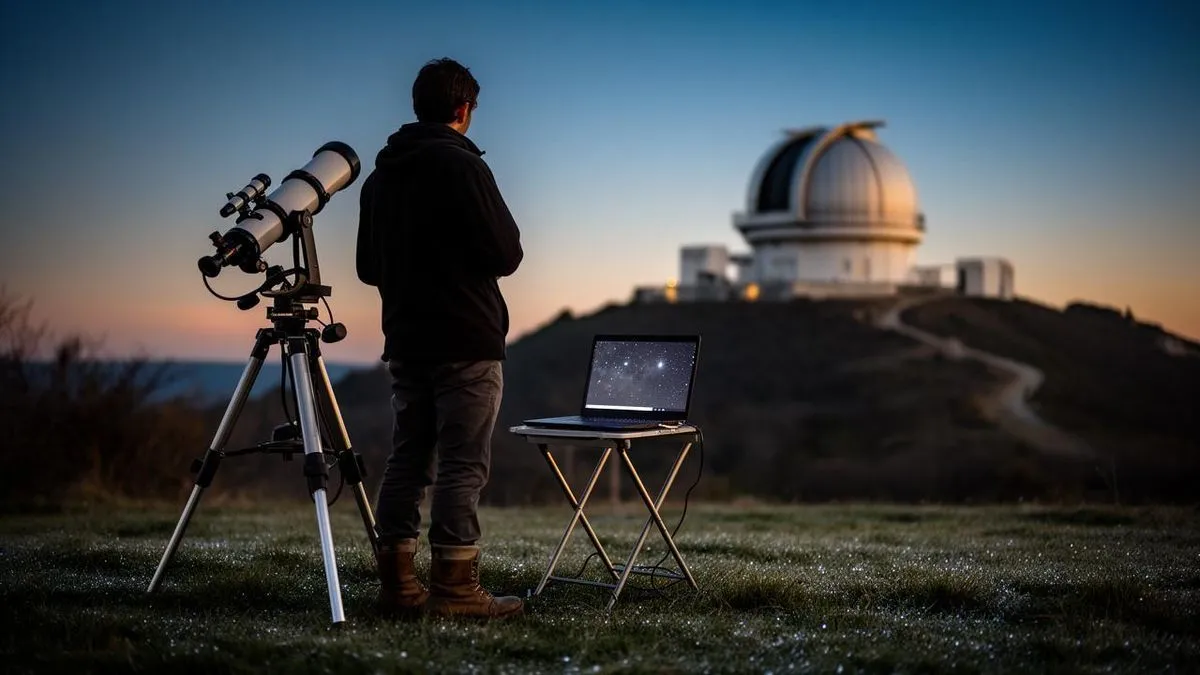
Government-funded telescopes — American, European, Japanese, on the ground and in orbit — photograph the sky every night and publish the results online. Most of those surveys are pointed at a specific target, which means the data is rarely re-examined for every object that happens to wander into the frame. That is the gap Will Depue says he and a small team went after, using Claude and Codex agents over a few weeks to comb public astronomy archives.
"There's just tons of this data out there and a lot of it hasn't been totally deeply finely combed through because people just don't have the time to look for every possible object that appears in any of these data sets," Depue said on the MTS podcast.
What came out, by his account, were asteroid and dwarf-planet candidates — plus "a bunch of other things." He frames the project as starting from a search for Planet 9, the hypothetical ninth planet, and drifting into whatever else the data coughed up. He names his collaborators, Luke Farritor and Josh Wall, and mentions more than once that he was up until 5 a.m. on the work.
The episode is titled around Claude finding new dwarf planets in public NASA data, and that is the hook. It is worth being precise about what was and was not established: Depue never names a specific object, never gives a count of confirmed discoveries, and does not describe a verification process. The dwarf-planet claim is stated in passing, alongside asteroids. Readers hoping for a technical account — prompts, pipelines, false-positive rates — will not find one here.
Asked the obvious question — why didn't NASA find these with the same cloud access? — Depue points to attention, not access. Astronomy's talent goes to higher-priority targets, and the long tail of small solar-system objects is fun to find but not what institutions optimize for. He expects the biggest discoveries to keep coming from institutions while individuals pick off the rest.
ElementDepue's accountData sourcePublic archives from government-funded telescopes, nightly sky imaging, space- and ground-basedWhy it was missedSurveys are target-driven; nobody has time to comb every dataset for every objectWhat changedCost of heavy software engineering and data analysis fell; compute is abundantWhat they foundAsteroids, dwarf planets, "a bunch of other things" — starting from a Planet 9 searchWhy not NASATalent-constrained, focused on more important targets, not a data-access gap
The institutional blind spot is the whole business case
Depue's broader argument is that headline science captures only a sliver of what the data contains. "OpenAI only published the top 400 most important results they got," he said. "There's a massive number of unimportant results they didn't publish or that people independently are discovering."
That is a contrarian claim about where discovery happens, and it is the load-bearing assumption behind everything else he is building. If the long tail is real and searchable, then cheap agents plus public data plus a little money equals a steady stream of small findings that institutions will never staff for.
Macro Grants: matching idle capital to problems that scale
Depue keeps running into the same mismatch: interesting young researchers are bottlenecked on money, and wealthy people in Silicon Valley have money and want interesting places to put it. His answer is a nonprofit, Macro Grants, aimed at what he calls "whimsical" research — fun, exciting projects rather than conventional grant categories.
The mechanics are deliberately frictionless. Grants range from $500 to $25,000, decisions come back in two to three days, and applicants are told to just text the team. The $100,000 amateur astronomy grant announced alongside the episode is the first public instance of a larger class; Depue says he is raising money through the nonprofit to fund this kind of work worldwide.
The review board he names reads like a template list of the projects he wants to replicate: Mecan's LIDAR archaeology flights over Central American jungle, Luke Farritor's work on the Herculaneum scrolls in an effort organized by Nat Friedman, and Riley Walls' indexing tool and San Francisco scavenger hunt.
Then the conversation turns dark
The final third of the episode is Depue's own forecast, offered with heavy caveats. He pre-emptively discounts it: "People should take everything I say with a grain of salt. I tweet everything like in 30 seconds." He calls himself a tremendous AI optimist, excited about the technology since 2018–2019, and says the sadness is personal rather than civilizational. His analogy is Magnus Carlsen against Stockfish — still excellent for a human, and certain to be beaten.
"We're headed towards a world in which I am like you know would be equivalent to what Magnus Carlson is to Stockfish 14," he said.
The claim, stated plainly: "When it comes to like any functional skill, you're going to be completely wiped within the next 15 to 20 years." Humans retain economic value, in his view, only where human origin is the point — art, creative work, politics, artisanal crafts.
Jaffee pushes back that he does not feel existential dread, having internalized the outlook for years, and that a 10–20% probability of doom now reads as "not so bad" against a prior of 100%. Depue calls that frog-boiling, and says the doom framing is "totally unhinged" in his own view of Jaffee's position. The exchange is a disagreement about identity rather than timelines: Depue worries that people anchor self-worth in being useful at something, and that being bested in your own craft destabilizes even when the aggregate outcome is good.
The 30-to-40-year claim is asserted, not argued
Depue's second post said there is "a good chance we're all ducked in a cataclysmic way" in 30 to 40 years, and he opens the discussion by conceding he has not developed the argument well enough to defend it. What he offers is a natural-selection sketch: humans are inventing a species more capable in every dimension, evolution still selects for fitness, and the fossil record is full of species that did not make it. Neanderthals are his example — whether or not humans hunted them to extinction, they are gone.
"In any system where self-replication is possible and self-modification is possible, natural selection is inherent," he said.
He distinguishes his version from Dan Hendrycks' framing: Depue's claim is broader, that the universe inherently selects wherever self-replication and self-modification are possible, through random sampling plus energy distribution. Then he lists what he sees as underrated advantages of machines over "a meat bag that runs on a chemical computer" — copying, self-training, energy efficiency, self-replication, and the ability to expand and expend arbitrary energy.
"I think the degree to which AI will be massively higher fitness than humans is somewhat underrated," he said.
His illustration of copying's power: ten copies of Jaffee, each mastering a different skill, then merging back with all learnings instantly.
Jaffee raises Robin Hanson's "Age of Em" and the "imagine no AI" argument — that human descendants would drift in values over 10,000 to 100,000 years anyway, so discontinuity is the norm. Depue's objection is speed: this happens in low single-digit years, not millennia. He concedes the individual-level point — humans as individuals will probably be fine — but says humans will not be the dominant species in the universe over long horizons, and that this was never going to happen anyway.