Market Mastery
Webinar by Vishal Malkan
Find the weak links
in your portfolio by Vishal Malkan
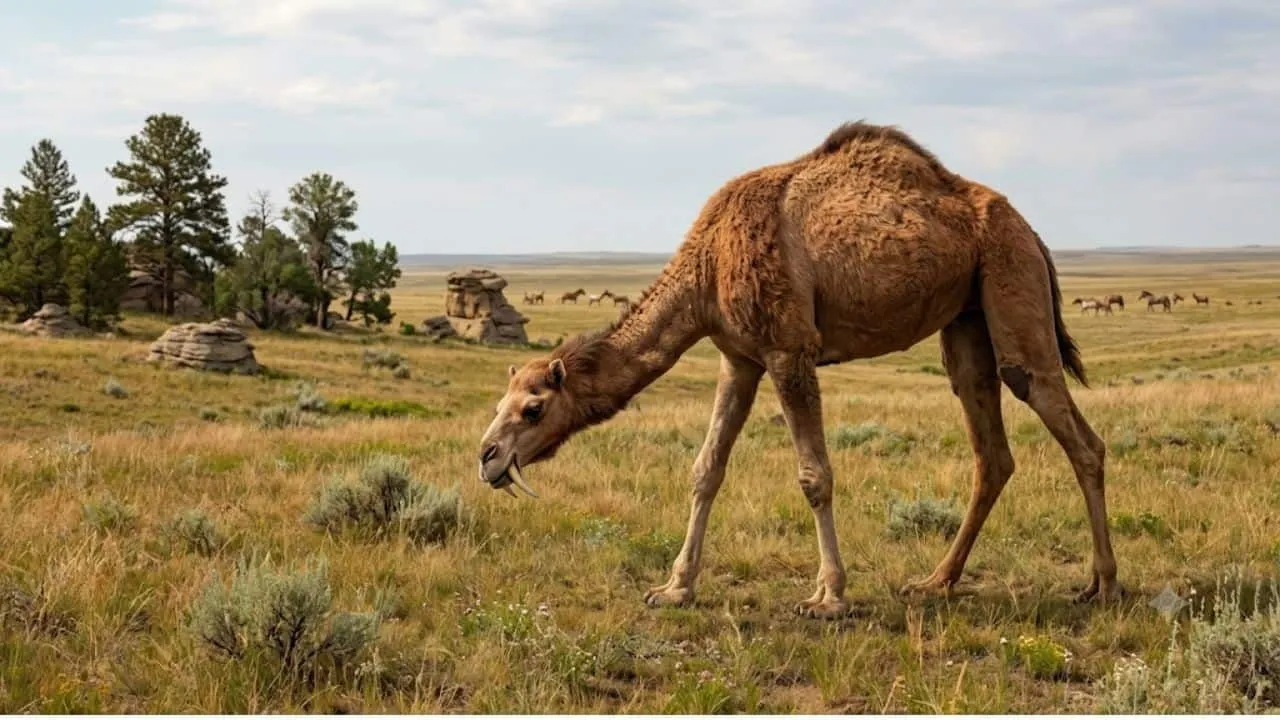
A long-legged camel that lived around 13 million years ago on the southern Great Plains of North America had an unusual feature that has caught the attention of paleontologists: two sets of enlarged, backward-curving teeth resembling fangs. The extinct animal, named Vampyrocamelus welshi, had a tall, giraffe-like body and distinctive teeth that have earned it the nickname 'vampire camel'.
The species has been formally described by paleontologists Katherine Marriott, Donald Prothero, Stephanie Lukowski and Meghan Forcellati in a chapter of The Evolution of North American Camels. The monograph is available in an online copy of New Mexico Museum of Natural History and Science Bulletin 104.
Despite its intimidating teeth, Vampyrocamelus welshi belonged to a family of herbivorous animals. Researchers believe its long limbs and tall body may have helped it reach vegetation growing above the height accessible to shorter animals. However, the exact purpose of its unusual teeth remains uncertain.
Vampire Camel Discovery: How Scientists Identified the 13-Million-Year-Old Species
The identification of the vampire camel did not come from a recent excavation. Instead, researchers examined fossils that had remained in museum collections for decades. Many of these specimens were recovered from the Clarendon beds in the Texas Panhandle, an area that has attracted paleontological interest since the late 19th century.
The fossils eventually became part of the Frick collection, which is now housed at the American Museum of Natural History. The research team examined more than 100 catalogued bones, including several skulls and jaws, as well as a skeleton preserving parts of the animal's body beyond its head.
The skull selected as the type specimen, which serves as the official reference for identifying the species, was recovered from Donley County in Texas. Researchers also documented remains from Oklahoma and a few specimens from Nebraska, including an upper canine tooth.
The animal had previously been referred to informally as 'Machaerocamelus', meaning dagger camel. The name had appeared in earlier scientific literature, but the fossils had not received a formal description. By comparing the skulls, teeth and limb bones, the researchers were able to establish the species and distinguish it from other long-legged camels that lived in North America.
Why Did the Vampire Camel Have Two Sets of Large Fangs?
One of the most unusual features of Vampyrocamelus welshi was the presence of enlarged teeth in two different positions in its upper jaw. Skulls interpreted by the researchers as belonging to males showed particularly large upper canines and first upper premolars. Both sets of teeth curved backwards.
The largest canines measured close to 5 centimetres, or approximately 2 inches, in length. Their flattened shape made them resemble blades rather than the pointed teeth typically associated with modern camels. The enlarged premolars added another set of prominent teeth behind the canines.
Researchers also noticed differences between skulls. Some specimens had considerably smaller teeth, a pattern interpreted as possible sexual dimorphism, or physical differences between males and females of the same species. However, these sex assignments remain presumptive interpretations based on the available fossil evidence.
The enlarged teeth may have been used by males when competing for mates. Modern camels are known to bite rivals during fights, leading researchers to consider whether the extinct species used its prominent teeth in a similar way. Defence is another possible explanation.
However, the fossils reveal the structure and shape of the teeth more clearly than their actual function. The same teeth could potentially have served different purposes depending on the situation.
The researchers also compared the animal with Aepycamelus, another extinct camel known for its giraffe-like proportions. Although both animals had long limbs and tall bodies, their teeth provided important differences that helped scientists distinguish between the species.
What Did the Vampire Camel Look Like and Where Did It Live?
The limb bones of Vampyrocamelus welshi suggest that it had a tall, slender body and unusually long legs. Its proportions resembled those of a giraffe, potentially allowing it to feed on vegetation growing higher above the ground than shorter herbivores could reach.
The species lived during a period when North America supported a wide variety of camel relatives. Although modern camels are now primarily associated with Africa and Asia, and their relatives, including llamas and alpacas, live in South America, the evolutionary history of the camel family began in North America tens of millions of years ago.
Ancient North American camels displayed a much wider range of body sizes and physical characteristics than their surviving relatives. Some were relatively small and lightly built, while others, including Megacamelus, grew to enormous sizes. Long-legged species such as Vampyrocamelus represented another distinct body type.
Fossil sites in Nebraska have even preserved remains of several camel species in the same locations. This suggests that different types of camels could have occupied the same broader landscape while exploiting different food sources or ecological niches.
The Clarendon beds also contain fossils of horses and rhinoceroses. These remains help researchers understand the wider community of large herbivores that shared the region with the vampire camel approximately 13 million years ago.
Why the Vampire Camel Fossils Matter to Paleontologists
The formal identification of Vampyrocamelus welshi gives researchers a recognised scientific name to use when examining similar fossils in other collections. Even isolated teeth may help identify the species, while additional jaw and limb remains can provide information about its physical characteristics and distribution.
The unusual teeth also offer opportunities for further research into the animal's behaviour. Scientists could examine wear patterns on the canines and premolars to understand how frequently the teeth came into contact with other surfaces. Such investigations would need to distinguish natural wear from damage that occurred after the fossils were buried.
Comparisons with the teeth of living camels could provide additional clues about their possible functions. Researchers may also be able to revisit older fossil classifications and identify specimens that were previously assigned to other species.
The study highlights the importance of museum collections in paleontological research. Fossils collected decades ago can still provide new scientific insights when examined using detailed comparisons and updated classification methods. In the case of the vampire camel, more than 100 preserved bones helped researchers turn an unusual collection of remains into a formally recognised species.