Over 30 percent of all plastic produced on our planet is mismanaged. It enters the environment and then remains there almost forever. An example is polyethylene, which is one of the world’s most widely used plastics — virtually all packaging, bottles, and bags are made from it — that can persist for centuries no matter how deep down you bury it.
Scientists have struggled to develop practical and scalable alternatives that offer the flexibility and durability of conventional plastics without leaving behind the persistent and highly polluting waste.
However, now a promising solution has emerged from underground bee nests. A new study has revealed that a material produced by cellophane bees behaves like polyethylene, yet breaks down rapidly in natural soil.
Understanding how these insects make it could help researchers design a synthetic version that perform like conventional plastics but do not pollute the environment for generations.
“Unfortunately, most polyethylene-like polyesters exhibit little biodegradability due to their crystallinity and hydrophobicity. This work exposes a remarkable natural exception to this pattern in the nest linings of the “cellophane bee,” the researchers note.
The bees that make their own plastic
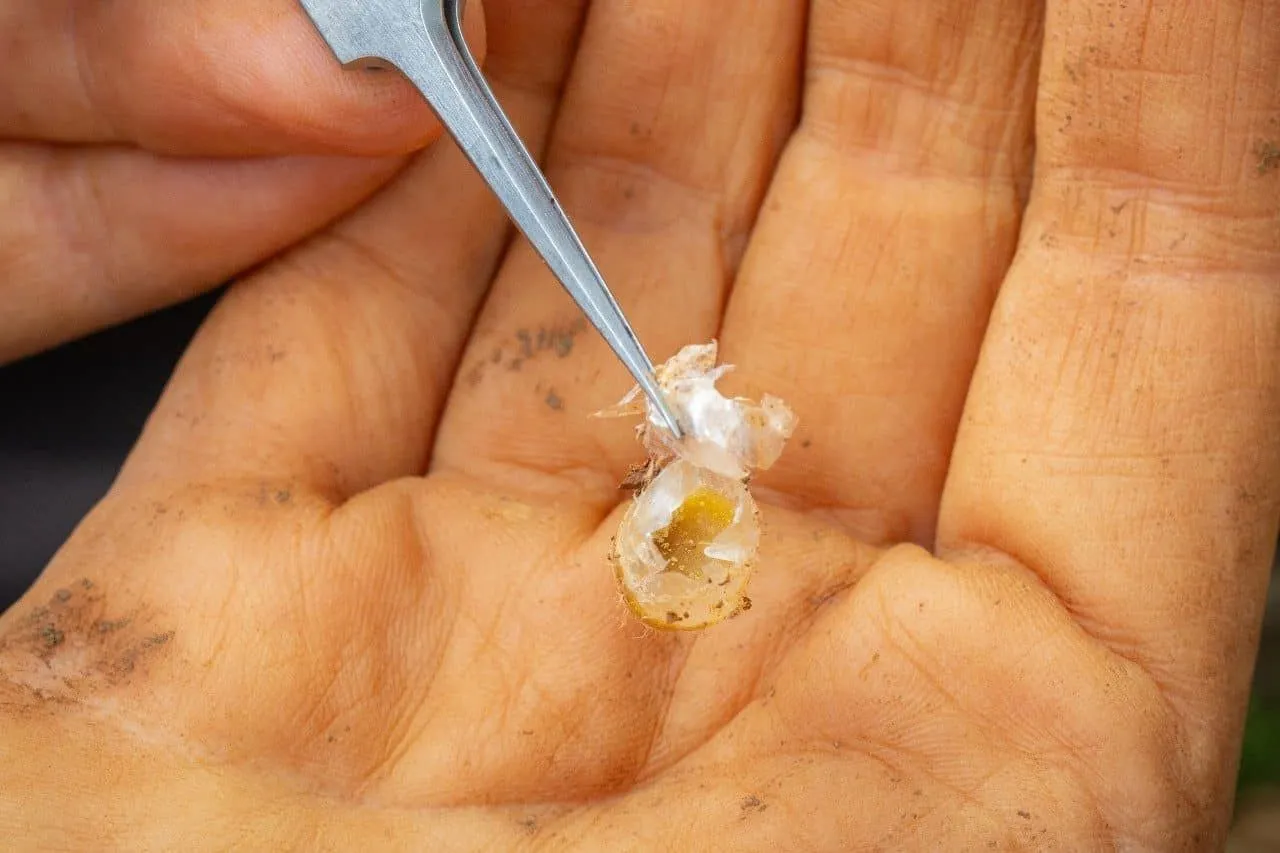
Cellophane bees (Colletes inaequalis) are native to North America. They’re solitary insects that build underground nests, lining their chambers with a thin, flexible and translucent material that resembles plastic.
Scientists first identified this unusual substance nearly 50 years ago. The bees produce it using a specialized gland called the Dufour’s gland, whose secretions form a natural polyester that coats the walls of their nests and protects their developing young ones.
What makes this material particularly interesting is that it does not appear to accumulate in the soil, even when generations of bees repeatedly use the same nesting grounds.
While explaining the scale of this phenomenon, the study authors said, “Bees of this genus nest annually in aggregations that can consist of more than 10,000 individual nests, with subsequent generations of bees returning to the same aggregations and building new nests underground every year for decades.”
“Despite this perpetual addition of plastic into the soil, and despite Colletes polyester having a lower ester density than either PPDL or PE-18,18, plastic does not appear to accumulate in Colletes aggregations,” they added.
This is unusual because the bee polyester resembles polyethylene in how its molecules are packed. Comparable synthetic materials are notoriously difficult to break down, often resisting degradation even under industrial composting conditions.
So then what makes the natural version behave so differently?
Tracking how the bee-made plastic breaks down
To investigate, the researchers examined newly constructed nest linings and compared them with samples collected from the same nesting site after four, seven and 11 months. They used chemical analysis, microscopy, heating measurements and X-ray scattering to investigate the material’s deterioration.
The results revealed surprisingly rapid degradation. Bee polyester initially accounted for approximately 73 percent of the nest lining’s weight. After four months in natural soil, that proportion had dropped to 40 percent.
By seven months, the material had developed visible cracks, and after 11 months, it had become brittle and prone to crumbling.
Despite this, the fresh material was remarkably flexible. It could be folded or crumpled while retaining its original shape, a combination of properties that could make it an interesting model for disposable plastics.
The molecular clues behind its unusual behavior
The researchers next investigated the material’s molecular structure. One surprising finding was that approximately 60 percent of the fresh polyester had a crystalline structure, meaning some of its molecules were arranged in organized regions.
Crystallinity generally makes plastics more resistant to degradation because tightly packed molecules make it harder for water and enzymes to reach the chemical bonds holding the material together. Yet the bee polyester seemed to defy this expectation.
Despite the fact that many of its molecules formed crystalline regions, these regions did not develop into larger, highly organized structures commonly found in plastics. This could leave more ester bonds exposed to water and enzymes, making the material easier to break down.
However, more experiments are needed to establish whether this structural arrangement explains its rapid deterioration.
The researchers also found that the polymer chains were connected to one another, forming a cross-linked network. This helped the material resist dissolving, even in hot solvents such as toluene and trichlorobenzene.
Another possible clue came from enzyme tests. Both fresh and four-month-old nest linings showed esterase activity against a test substance. Esterases are enzymes that can break ester bonds in polyester, suggesting they might contribute to the material’s breakdown.
Overall, it seems like the biodegradability of bee polyester is owed to some combination of structural and possible biological factors, although the exact mechanism remains unresolved.
Could bee nests inspire better plastics?
Instead of sacrificing the useful properties of polyethylene-like materials, scientists could investigate how the bees’ natural polyester combines flexibility with relatively rapid degradation.
However, the nest lining is not a ready-made replacement for commercial packaging right away. Researchers still need to figure out exactly why it breaks down so quickly and whether those same properties can be reproduced in a factory.
If scientists can translate these natural design principles into synthetic materials, the humble cellophane bee could offer valuable lessons for tackling one of modern society’s most persistent pollution problems.