Market Mastery
Webinar by Vishal Malkan
Find the weak links
in your portfolio by Vishal Malkan
Physicists at CERN have found the first evidence of an extremely rare particle decay after more than four decades of searching. The process is predicted to occur only once in every 10 billion beauty particles. The finding could help scientists explore the 'Zeptoverse', an extremely small scale of nature where unknown particles and fundamental forces may exist.
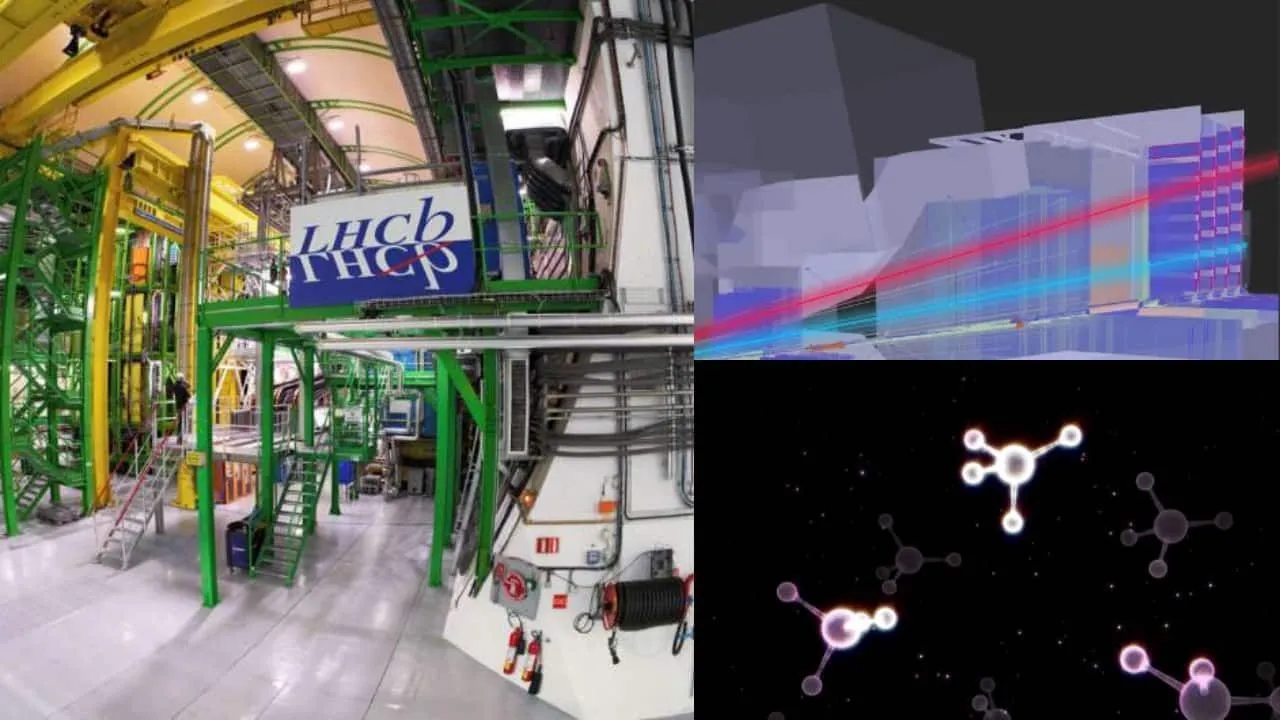
The discovery comes from the upgraded Large Hadron Collider beauty (LHCb) experiment at CERN's Large Hadron Collider (LHC). Researchers say the result offers a new opportunity to test the Standard Model, the leading theory explaining fundamental particles and their interactions.
What is the "Zeptoverse"?
The Zeptoverse refers to a scale of nature involving distances as small as a zeptometre, which measures (10^{-21}) metres. This is one billionth of a trillionth of a metre. Studying nature at these incredibly small scales could help scientists investigate particles and forces that have not yet been detected. Such research may reveal gaps in our understanding of the universe.
What did CERN scientists discover?
The LHCb collaboration found evidence of a rare process known as 'Bd to mu mu'. It involves a particle containing a beauty quark and a down antiquark decaying into two muons. Muons are heavier relatives of electrons. Scientists predict that this decay occurs only around once in every 10 billion beauty-particle decays.
Researchers have searched for this process for more than 40 years. The latest result reached a statistical significance of 3.2 sigma, marking the first evidence of this decay from a single experiment.
How did the LHCb experiment help?
The upgraded LHCb detector can record particle collisions at up to five times its previous rate. Researchers combined data collected during 2024 and 2025 with earlier observations from 2011 to 2018. Improved particle identification and machine-learning techniques helped scientists separate the rare signal from background events produced during collisions.
Does this mean new physics has been found?
Not yet. The measurement agrees with predictions made by the Standard Model. In particle physics, a five-sigma statistical significance is generally required to claim a discovery.
Scientists plan to collect more data into the early 2030s. A further upgrade could increase the experiment's data collection rate by another factor of 10, allowing researchers to investigate rare decays and search for signs of previously unknown particles.