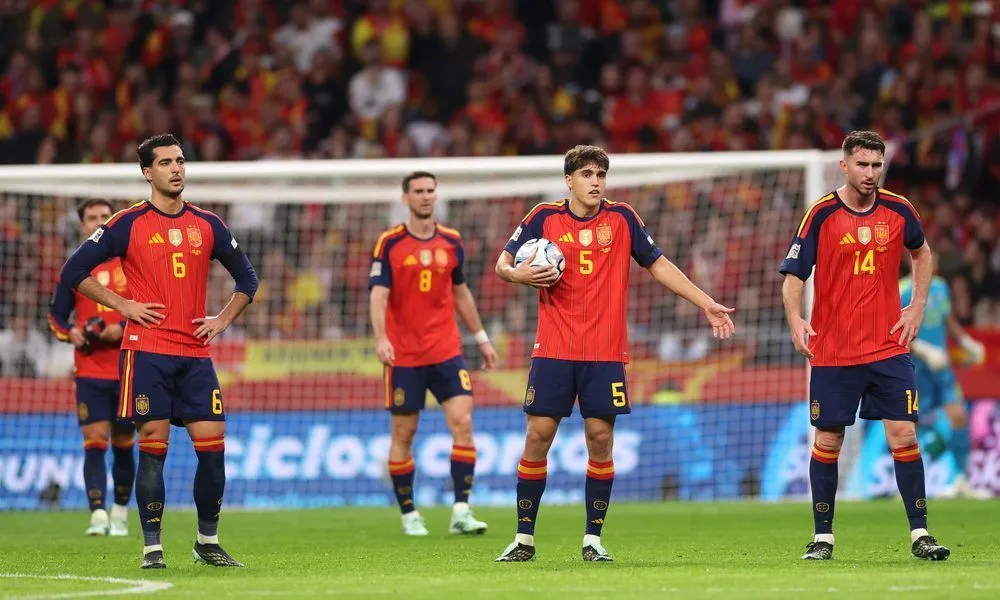
Barcelona are awaiting the results of medical tests on Pau Cubarsi after the defender was substituted at half-time during Spain’s 3-2 defeat to England in the UEFA Nations League on Sunday, November 15.
Journalist Fabrizio Romano confirmed that the Spanish Football Federation (RFEF) had informed Barcelona that the 19-year-old was experiencing discomfort around his hip and would require further examinations to establish whether he had sustained an injury.
The development is a concern for Hansi Flick, who relies heavily on Cubarsi, especially at a time when Barcelona are already dealing with defensive worries.
Although the initial assessment suggests the problem might not be serious, Barcelona will need medical confirmation before determining his availability for upcoming fixtures.
Cubarsi substitution raises concerns
Cubarsi started against England at the Metropolitano but did not return for the second half, with Real Madrid defender Dean Huijsen replacing him after the interval.
The Barcelona centre-back had been involved in a significant moment shortly before half-time, conceding a penalty after bringing down Harry Kane, who converted to give England the lead.
Notably, nothing in the first half suggested Cubarsi was struggling physically, although he later cited discomfort as the reason for his withdrawal, leaving uncertainty over whether the problem developed during that incident.
Spain eventually lost 2-3 despite scoring twice in the second half, with the defeat also ending their 43-match unbeaten run.
Luis de la Fuente plays down the problem
Spain manager Luis de la Fuente offered some reassurance after the match, although he stopped short of ruling out an injury.
Discussing the players who experienced physical problems against England, he said, “Pubill has an ankle problem, Cubarsi suffers from muscle discomfort and Zubimendi too.”
The comments suggest Cubarsi’s withdrawal was precautionary rather than an indication of a serious, established injury. However, the extent of his injury can only be established through the examinations planned in Barcelona.
For now, the initial impression is that the problem did not appear significant, but neither the Spanish federation nor Barcelona had established a definitive diagnosis at the time of the reports.