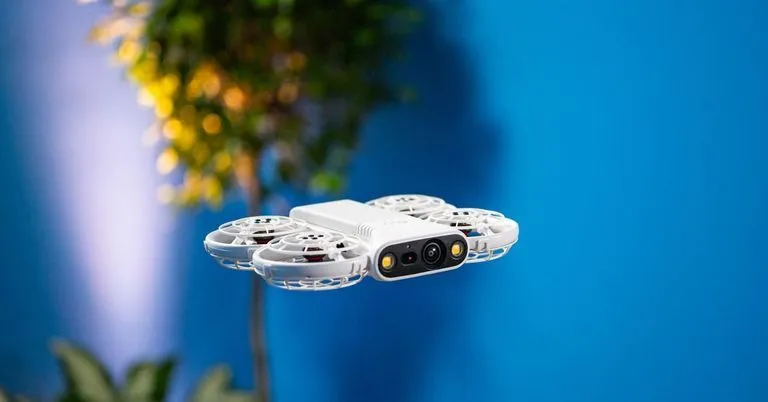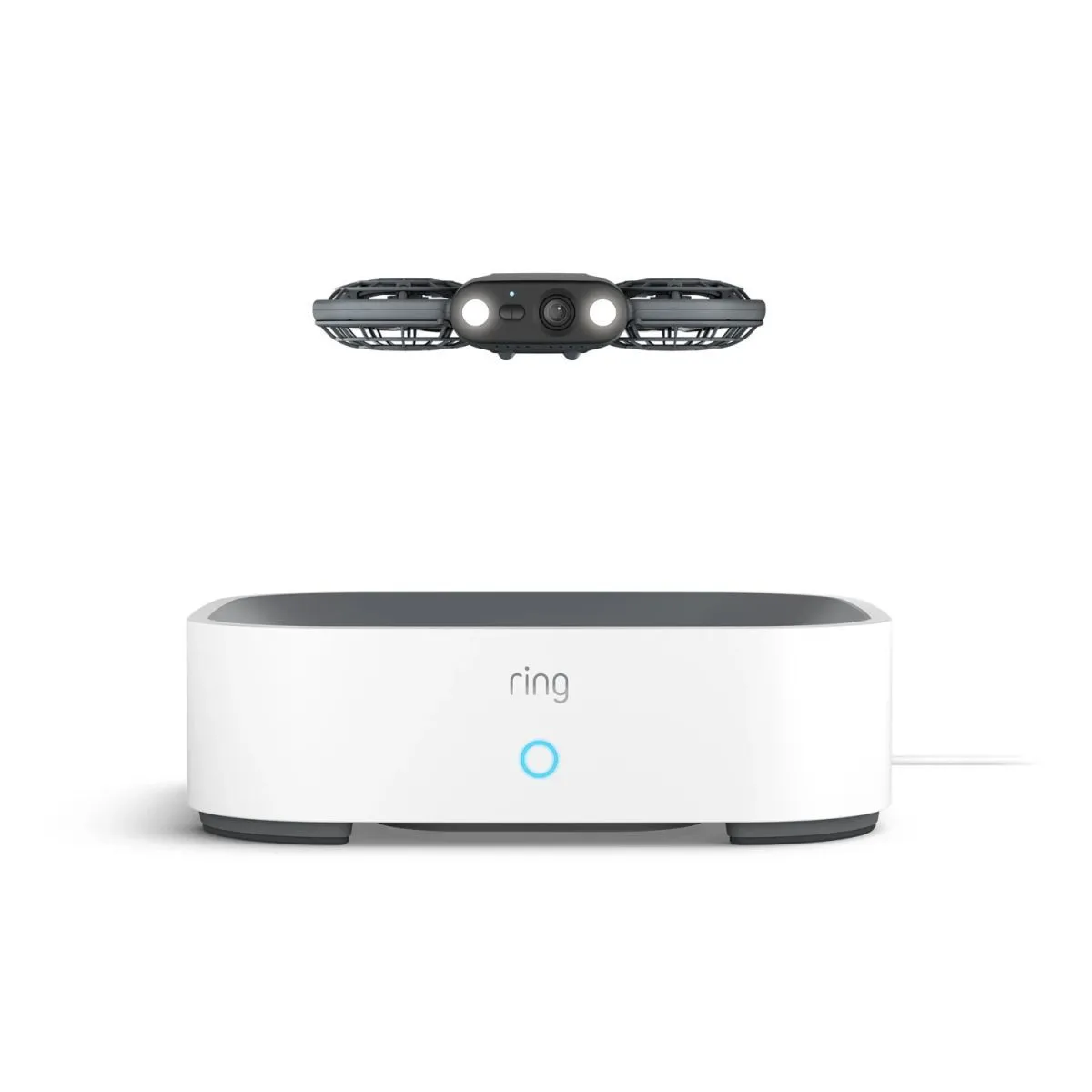
Ring is moving into robotics. The Amazon-owned home security brand said Tuesday it is forming a new division, Ring Robotics, and launching two autonomous devices: a flying indoor camera aimed at homeowners and a wheeled patrol robot built for businesses.
The Ring Drone Cam will sell for $249.99 and ship Jan. 27, 2027. The Ring Rover Cam goes on sale Dec. 16 at $1,000. Both were announced at a media briefing in New York and represent the first products in what the company calls a category of autonomous, mobile security.
The drone is a 165-gram quadcopter with a 2K camera and two LEDs on its front, a 1080p camera underneath and a downward-facing light. Ring pitches the moving lights as a deterrent: in a dark house, the company says, they mimic a guard sweeping a flashlight around a room. The device can fly on preset schedules, launch when a motion or leak sensor trips elsewhere in the home, or be sent manually. Users can tap a location on Amazon's Alexa Home Map, a 3D rendering of the home announced last month, and the drone plots its own route.
Flight time runs roughly eight to 10 minutes depending on altitude, since climbing forces the propellers to work harder. When the battery runs low or Wi-Fi drops, the drone lands or returns to its dock, where eight minutes of charging yields about a minute of flight.
Ring founder Jamie Siminoff said the company has been working on a drone concept since 2016, two years before Amazon acquired Ring, and that earlier versions were shelved because they were not good enough. A 2021 model was boxed but never shipped; a 2025 attempt ran into a cycle in which added sensors demanded more computing power, which demanded bigger batteries, which added weight and forced larger propeller shrouds that reduced airflow. Doing all of that in the device, he said, would have pushed the retail price past $5,000.
What changed the economics was moving the intelligence to the cloud. Ring calls the system AI Pilot, and it powers both new products. According to the company, it "maps the space, suggests patrol points, and autonomously navigates around obstacles," using specialized vision models, sensors and cloud processing. The drone therefore leans heavily on a Wi-Fi connection rather than an onboard AI model.
The Rover Cam is the second device and shares its lineage with Amazon's Astro robot, which was announced in 2021 as a domestic helper, later repositioned as a business security guard, and discontinued in 2024. Ring said the Rover "was originally inspired by feedback from Amazon Astro customers who said the feature they loved most was roving security." The machine looks much like Astro: a tablet for a face, a camera mounted above the screen, a round wheel housing, and a light tower on its back.
Aimed at warehouses and small to mid-sized businesses, the Rover streams 4K video, can rotate 360 degrees and can raise its camera up to 4 feet on a periscope to see over obstacles. It carries a siren audible from more than 10 feet away, a speaker and microphone for two-way audio, and a light tower that projects a blue ring onto the ceiling for locating the unit and flashes red when the alarm sounds. It records while traveling to a destination, not only on arrival, and watches for person motion even while docked.
FeatureRing Drone CamRing Rover CamPrice$249.99$1,000AvailabilityJan. 27, 2027Dec. 16Primary marketHomesBusinessesCamera2K front, 1080p underside4K, periscope to 4 ftNotable hardwareLEDs, 165 g airframeSiren, two-way audio, light towerNavigationScheduled or sensor-triggered flight; Alexa Home MapScheduled routes, sensor response, Alexa Home Map
Note: Prices and dates as announced by Ring.
Privacy is likely to be the central question. Ring has faced years of criticism over camera networks that police departments can access, and flying cameras inside a home raise the stakes. Amazon said privacy is "the default" for Ring Robotics: the drone powers down and switches off its camera while docked, recording only when a flight is triggered. Video from both devices is protected by TAKE, or Throw Away the Key Encryption, which Ring describes as its strongest default encryption. The company has not said whether local storage will be offered; Ring cameras generally record to the cloud. Ring also argues the devices are meant to be seen and heard, with the drone's propeller noise and the Rover's light tower serving as deterrents.
The launch lands in a market that has resisted automation. Amazon's Astro never reached mass adoption, and the enterprise version was retired after about seven months on sale. Ring is betting that cheaper hardware and cloud-hosted navigation can succeed where a $2,350 robot did not, and that the same software can serve a homeowner and a warehouse operator. For Amazon, the products extend the Alexa Home Map into a control layer for physical security hardware, tying the smart-home platform to recurring device and subscription revenue. Whether buyers accept a camera that flies through their hallways, and whether businesses trust a robot to patrol after closing, will determine if Ring Robotics becomes a durable line or another shelved experiment.