With advancements in technology over the past several decades, particularly through media like video calling, the world has shrunk. We’re much more in touch with each other than we’ve ever been. But it’s still just sound and vision. Is that about to change though? Because researchers at Ohio State University have developed a device that can transmit smells from one person to another over long distances. The technology comprises two separate components: on one side, an “e-nose” electronic odour-sensing device identifies the main classes of odours present in the air around it, and transmits these data to the remote device at the other end, which uses a chemical “palette” of scents to blend a similar smell there, which is diffused into the air using a piezo-electric atomiser. Both devices are extremely compact, meaning that they could even be incorporated into webcams or even wristbands and necklaces. The team hopes to use the “Scentronic” device not just to add an extra dimension to Zoom and Teams calls, but also for diagnostic purposes. It’s the brainchild of Ohio State PhD student Chunyu Yang…
Chunyu - The thing that we have been working on is that we want to create a framework that can sense odours, and transmit the odours, and then regenerate the odours somewhere else.
Chris - I remember someone saying something similar many years ago, and they called it smelly vision. Is that sort of what it is? So you could have a video call, and you could smell my aftershave, for example, because a device could work out what I smell like and then recreate the smell of me for you.
Chunyu - Yeah, exactly like that.
Chris - What's involved in doing that for real, though?
Chunyu - What we've done is that we create kind of two devices. One of them is an electronic nose, and it can smell the odours. And the other device, we call it an odour generator, and we are using a small device that has a very micro hole inside it, and it can vibrate. It will make the scented liquid, like perfume, release it into small droplets and then get into air, like the odours, and then we use internet to connect this to a device.
Chris - There are thousands of different molecules that create smells or lead to things having the odour profile that they do. So can your e-nose detect all of them? And how good is your scent-creating device at recreating the same odour profile?
Chunyu - Firstly, our e-nose couldn't recognise any molecule in that chemical profile of odours, which is very difficult. So the strategy we use is to use machine learning models. So we discard the molecule details. We just try to learn the general category that this odour belongs to. So in this way, we also can smell it, but we will smell it in a rough category rather than the detailed molecule. And for the odour generator, we actually right now are using some commercial perfume that corresponds to the odour we smell, so the generation actually depends on your choice of the perfume.
Chris - Is this the sort of smell equivalent of what happens when I take a photograph and I then compress the image, or when I record some audio, and I compress the audio, and I throw away some of the data because you don't need all of it to get a pretty good rendition of what you're hearing or what you're seeing? Here, you're guessing or throwing away a lot of the olfactory, the odour information because you only need a small amount of information to create something that smells pretty similar to what was detected in the first place. Is that the basis of how this works?
Chunyu - Yeah, exactly. Not the totally same, but we would like to just know the category of the odours and what kind of information is extracted when it is learning the odours is still a black box because it's in a machine learning model, but the thing we know is that the machine learning model will learn the features of the odour profile and then remember it.
Chris - How big are the devices at each end? In other words, is this practical for, say you and me want to have, we're having a conversation over the internet right now. How practical would it be for me to have a gadget that would enable me to experience the smell of where you are, for example? Is it down at the sort of size that this becomes portable?
Chunyu - Yeah, that's one of the important features we want to claim about this work is that we are choosing the strategy, the technique that doesn't need a big size. So, for the e-nose, we're using a gas sensor array. The gas sensor is similar to the one that's in your kitchen, those gas alarm, they are similar thing, but we use an aerial thing and then we use a printed circuit board, which also can be very compact. So the overall size is portable.
Chris - And what about recreating the scent at the other end? What would I have to have here so that I could smell you?
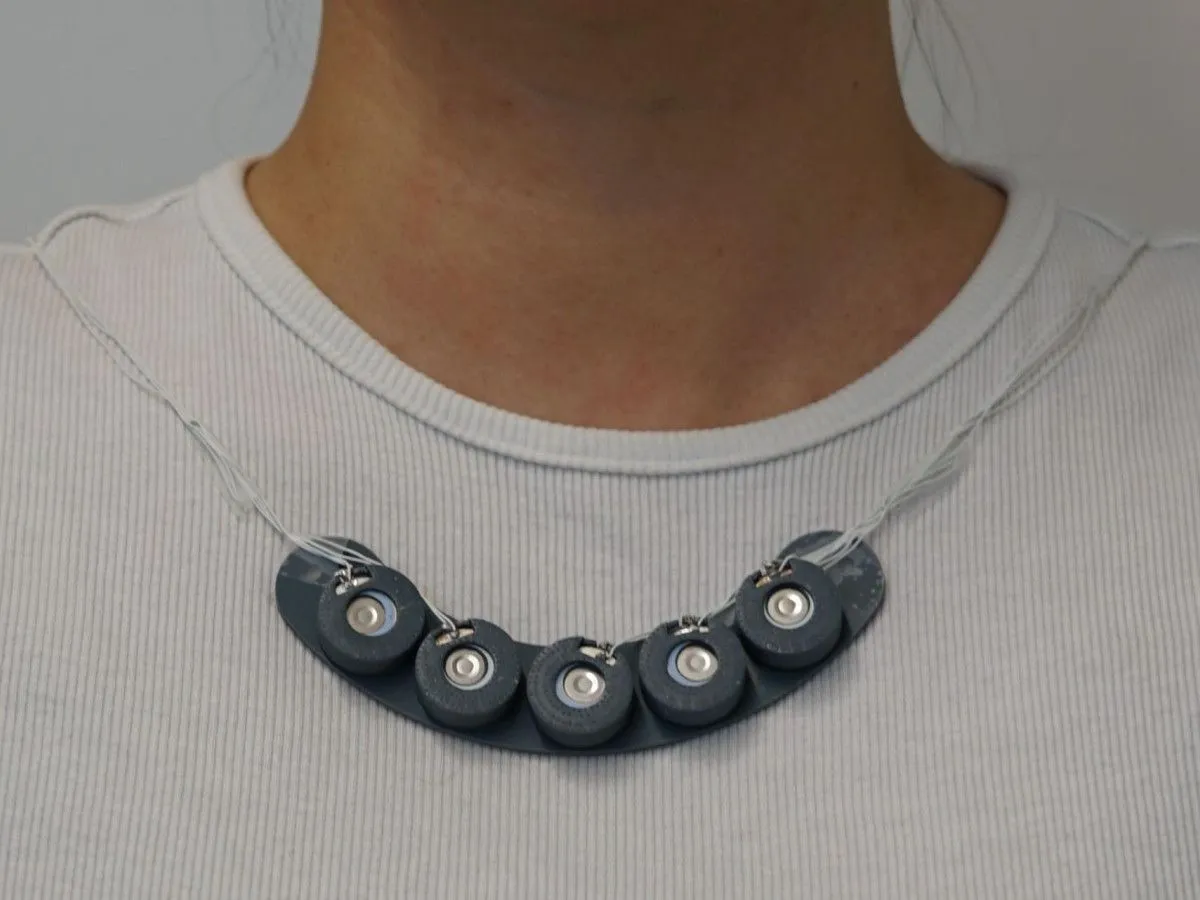
Chunyu - Oh yeah, the other generator is also very portable because we are using a piezo atomiser, which is a kind of very thin film of piezo ceramic. It's a kind of ceramic and is also controlled by a circuit board, which can be very thin. And also, we kind of create different structures, and we use 3D printing to print the overall structure. So it can be a waistband, it can be a necklace, it just depends on how you design it.
Chris - So the webcam of the future could very easily incorporate a small gas analyser to send the smell of an environment and a simple system at the other end to recreate these smells. They can be made very compact indeed.
Chunyu - Yeah.
Chris - What can we do with it? Where does it cease to be just a gimmick and a bit of fun and make a Zoom call a bit more interesting? And where does it become something where people can rely on this to really help them to do certain things?
Chunyu - Yeah. We also claim one of the applications is in healthcare. For example, there are people who kind of lose their olfactory function somehow. And our device can also be used in those scenario that a doctor can remotely diagnose a patient's olfactory function and also using this device to stimulate their nose and make some treatment based on it.
Chris - I wondered if you were going to say that it would enable doctors to smell their patients because there are some disorders that do change the way people smell. I'm thinking a person with diabetes, for example, might smell very, very sweet because they're breaking down ketones or producing ketones from the breakdown of body fat. And that's a giveaway that doctors might look for. So is being able to sniff your patients remotely also on the cards with this?
Chunyu - Yeah, I think that's also a possible application for it, because in our study, we have this e-nose part, which can smell the odours. So once this e-nose gets specifically trained on those odours, you know, that are involved in that disease. So, yeah, so that's also a very promising application for this e-nose.