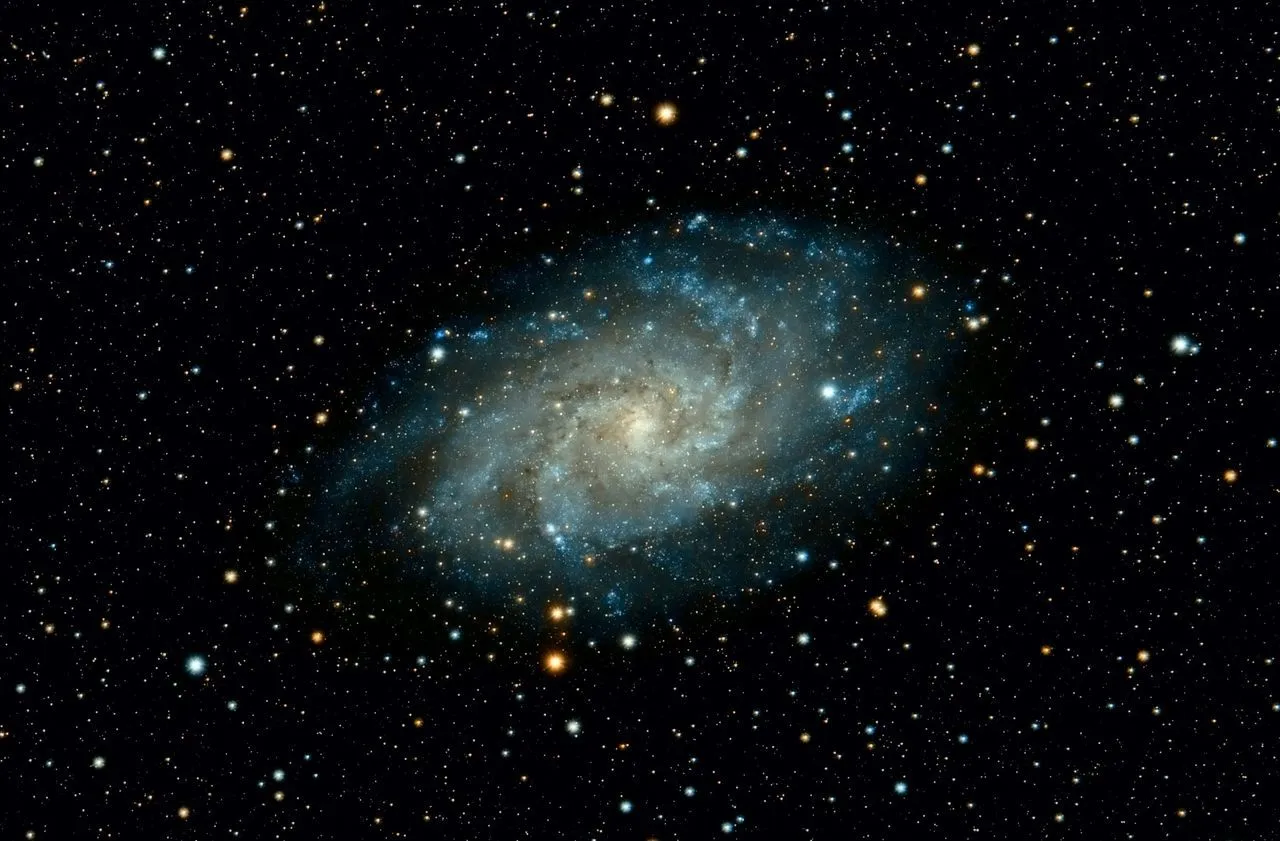
NASA this week spotlighted one of the more beautiful — and scientifically unsettling — objects in the nearby universe: NGC 4449, a small, bow-tie-shaped galaxy blazing with blue star clusters and pink nebulae roughly 12 million light-years away in the constellation Canes Venatici. The image, captured by the Hubble Space Telescope, anchors a new study that is forcing astrophysicists to rethink a cornerstone of galaxy science.
The finding is deceptively simple: dwarf galaxies are keeping almost none of the oxygen their stars produce. And the implications reach all the way to Earth.
The Great Oxygen Heist
As part of the Galaxies Losing Oxygen via Winds (GLOW) project, funded by NASA and the National Science Foundation, researchers examined 37 nearby dwarf galaxies — small stellar systems ranging from roughly 3 million to 3 billion times the mass of the Sun, all within about 19.5 million light-years of Earth.
The team used archival Hubble Space Telescope observations to resolve individual stars inside each galaxy and reconstruct its entire star-formation history. From that history, they calculated the total amount of oxygen those stars should have produced over the galaxy's lifetime. Then they measured how much oxygen was actually still there.
The answer was stark: the galaxies had kept only 4% to 25% of the oxygen their stars made, with an average retention of around 11%. Nearly nine-tenths of the heavy elements forged in stellar furnaces had been blown away.
"Oxygen is produced by stars, which are inside of galaxies," said Grace Telford, co-investigator and an assistant professor at the University of Utah. The question the study set out to answer was why so little of it stays there.
The results appear in The Astrophysical Journal.
Why Small Galaxies Can't Hold On
The culprit is a well-known but previously underestimated process: stellar feedback.
When a massive star — one roughly eight or more times the mass of the Sun — exhausts its nuclear fuel, it collapses and detonates as a core-collapse supernova. That explosion releases an enormous amount of kinetic energy that heats surrounding gas to millions of degrees, creating a hot, expanding bubble. In a galaxy the size of the Milky Way, gravity is deep enough to trap most of this gas; it rises, cools, and eventually rains back down to form new stars — a recycling loop.
In a dwarf galaxy, the math is different. The gravitational potential is shallower. The energy from massive stars and supernova explosions drives material out of the host galaxies at velocities that exceed the galaxy's escape speed. The gas does not come back.
Critically, the outflowing gas is not an average sample of the galaxy's contents. The best-fit model for the GLOW data requires outflowing gas that is about twice as metal-rich as the galaxy's interstellar medium — meaning oxygen-enriched gas is preferentially selected for ejection. The supernovae that produce the oxygen are also, in effect, the engines that expel it.
The result, confirmed by Chandra X-ray Observatory observations of NGC 4449 itself, is a nearly one-way valve: stellar material flows out far more than it stays in, and what flows out is disproportionately rich in the elements stars worked hardest to make.
Where Does 89% of the Oxygen Go?
That is, in part, still an open question — and one of the most important ones in observational cosmology.
Earlier ultraviolet observations accounted for only about 1% to 7% of the missing oxygen in a highly ionized form around the galaxies. After correcting for other ionization states, the researchers estimated the surrounding gas halos — the circumgalactic medium — could hold between 5% and 35% of the expelled oxygen.
The circumgalactic medium is a diffuse halo of gas that surrounds every galaxy like an invisible atmosphere. If the missing oxygen is there, it could potentially be pulled back into future star formation. If it has been expelled beyond even that halo, into the broader intergalactic medium — the near-vacuum between galaxies — it may be gone from that galaxy forever, drifting as a contribution to the chemical enrichment of the cosmos at large.
Whether the missing oxygen resides in the circumgalactic medium or has fully escaped into the intergalactic medium remains an open question, one the team plans to address with future instruments.
The Models Were Wrong — by How Much, and Why It Matters
The GLOW results do more than document a surprising measurement. They expose a systematic error in the field's best tools.
Three cosmological simulations compared against the data all reproduce the general mass-metallicity relationship — the well-established observation that lower-mass galaxies have lower metallicity — but all predict that dwarf galaxies retain more metals than actually observed.
The mass-metallicity relation is one of the foundational scaling laws of observational cosmology. It has been reproduced by simulations for two decades and used to calibrate predictions about how galaxies evolve across cosmic history. The GLOW study shows that at the low-mass end — the range occupied by dwarf galaxies, which are the most common type of galaxy in the universe — those simulations are systematically miscalibrated.
To match the observed retention fractions, the best-fit model requires three specific departures from standard assumptions: outflows that remove proportionally more mass from smaller galaxies; outflowing gas roughly twice as metal-rich as the interstellar medium; and gas accretion suppressed by about 40%.
Each of those adjustments is significant. Together, they mean that the field's picture of how the smallest galaxies cycle their gas and metals — a picture baked into virtually every galaxy-formation model in use — needs revision.
The Cosmic Payoff: Seeding the Universe's Chemistry
The implications extend beyond galaxy evolution textbooks. Dwarf galaxies are not just abundant — they are the dominant contributors to intergalactic chemical enrichment throughout cosmic history.
Galactic winds unleashed by supernovae are apparently more effective at removing oxygen from low-mass galaxies than current models predict, and that efficiency makes dwarf galaxies extraordinarily generous donors to the intergalactic medium. Every expelled burst of oxygen-rich gas carries not just oxygen but other heavy elements — iron, carbon, nickel, magnesium, sulfur — the same elements that form rocky planets, fill oceans, and constitute living organisms.
The GLOW project examines how much oxygen stars produce, how much their galaxies keep, and how much escapes into surrounding space — which is ultimately a question about where Earth's chemical inventory came from, and why the universe is not simply a sea of hydrogen and helium.
The more efficiently dwarf galaxies shed their metals, the more of those metals were available in the intergalactic medium to be incorporated into later generations of stars and their planetary systems — including our own.
NGC 4449: A Living Example
NGC 4449 is a particularly striking illustration of the process the GLOW study documents. Although NGC 4449 is only a fraction the size and mass of the Milky Way, its rate of star formation is much greater — which means it is also generating supernovae at a higher rate and driving correspondingly powerful winds.
Chandra observations have directly imaged the hot outflowing gas from NGC 4449, making it one of the first irregular galaxies in which such outflows were identified. The galaxy's high star-formation rate and its shallow gravitational well make it, in effect, a natural laboratory for the process the GLOW study measures across 37 objects.
The Hubble portrait used in connection with the study is a composite image constructed through four filters spanning blue, green, hydrogen-alpha, and near-infrared light, produced by NASA, ESA, Alessandra Aloisi, and the Hubble Heritage team. The result shows scattered knots of intensely blue young star clusters, ribbons of pink ionized hydrogen, and wispy brown dust lanes — a galaxy that looks almost alive, and that is, in a sense, continuously exhaling the universe's future chemistry.
What Comes Next
Kristen Wingfield McQuinn, the GLOW principal investigator and an associate professor at Rutgers University, plans to extend the work using the Nancy Grace Roman Space Telescope to find fainter, smaller dwarf galaxies, then deploy Hubble and the James Webb Space Telescope to reconstruct their star-formation histories and push the measurement to lower galaxy masses.
Grace Telford (University of Utah) is meanwhile using Hubble to study the individual massive stars responsible for producing and ejecting oxygen — pushing the investigation down to the level of single stellar actors.
The goal is to understand not just the average behavior of a class of galaxies, but the star-by-star physics that drives the cosmos's most prolific chemical giveaway.
The GLOW study, "GLOW. II. A Census of Oxygen in Low-mass Galaxies," by McQuinn et al., appears in The Astrophysical Journal. The NGC 4449 image is credited to NASA, ESA, the Hubble Heritage–ESA/Hubble Collaboration, and Alessandra Aloisi (STScI/ESA).
Frequently Asked Questions
What did the GLOW study find?
Researchers examined 37 nearby dwarf galaxies and found they retain only 4% to 25% of the oxygen their stars produce, with an average of about 11%. The rest — roughly 89% on average — has been expelled into surrounding space by supernova-driven galactic winds.
Why do dwarf galaxies lose so much of their oxygen?
Dwarf galaxies have shallower gravitational wells than large galaxies like the Milky Way. When massive stars explode as supernovae, the resulting energetic winds can reach escape velocity and carry metal-enriched gas out of the galaxy entirely. The outflowing gas is also disproportionately rich in oxygen — about twice as metal-rich as the galaxy's internal gas — which accelerates the depletion.
Where does the expelled oxygen end up?
Ultraviolet observations suggest the circumgalactic medium — the diffuse halo of gas around each galaxy — may hold 5% to 35% of the expelled oxygen. The remainder may have escaped entirely into the intergalactic medium, the vast near-vacuum between galaxies. Whether it stays in the halo or escapes completely is one of the study's key open questions.
Why does this matter for the origin of Earth?
Oxygen and other heavy elements produced by stars in dwarf galaxies eventually became part of the intergalactic medium — the reservoir from which later generations of stars and planets formed. The more efficiently dwarf galaxies shed their metals, the richer that intergalactic reservoir is, and the more raw material was available to build rocky planets, oceans, and life.
What is the mass-metallicity relation, and why does the GLOW study challenge it?
The mass-metallicity relation is a well-established observation that lower-mass galaxies have lower metallicity (fewer heavy elements). Galaxy-formation simulations have reproduced this relation for decades. The GLOW study shows that at the low-mass end — dwarf galaxies — those simulations systematically overpredict how many metals these galaxies keep, meaning the models are miscalibrated for the most common type of galaxy in the universe.
What comes next for this research?
The GLOW team plans to use the Nancy Grace Roman Space Telescope to find fainter, smaller dwarf galaxies, then follow up with Hubble and the James Webb Space Telescope to reconstruct their star-formation histories. A parallel effort by co-investigator Grace Telford is studying the individual massive stars responsible for the ejections at the single-star level.